Folk Ways · May 2026
One Shoe, Up the Chimney
The commonest English magical practice, and nobody wrote down why
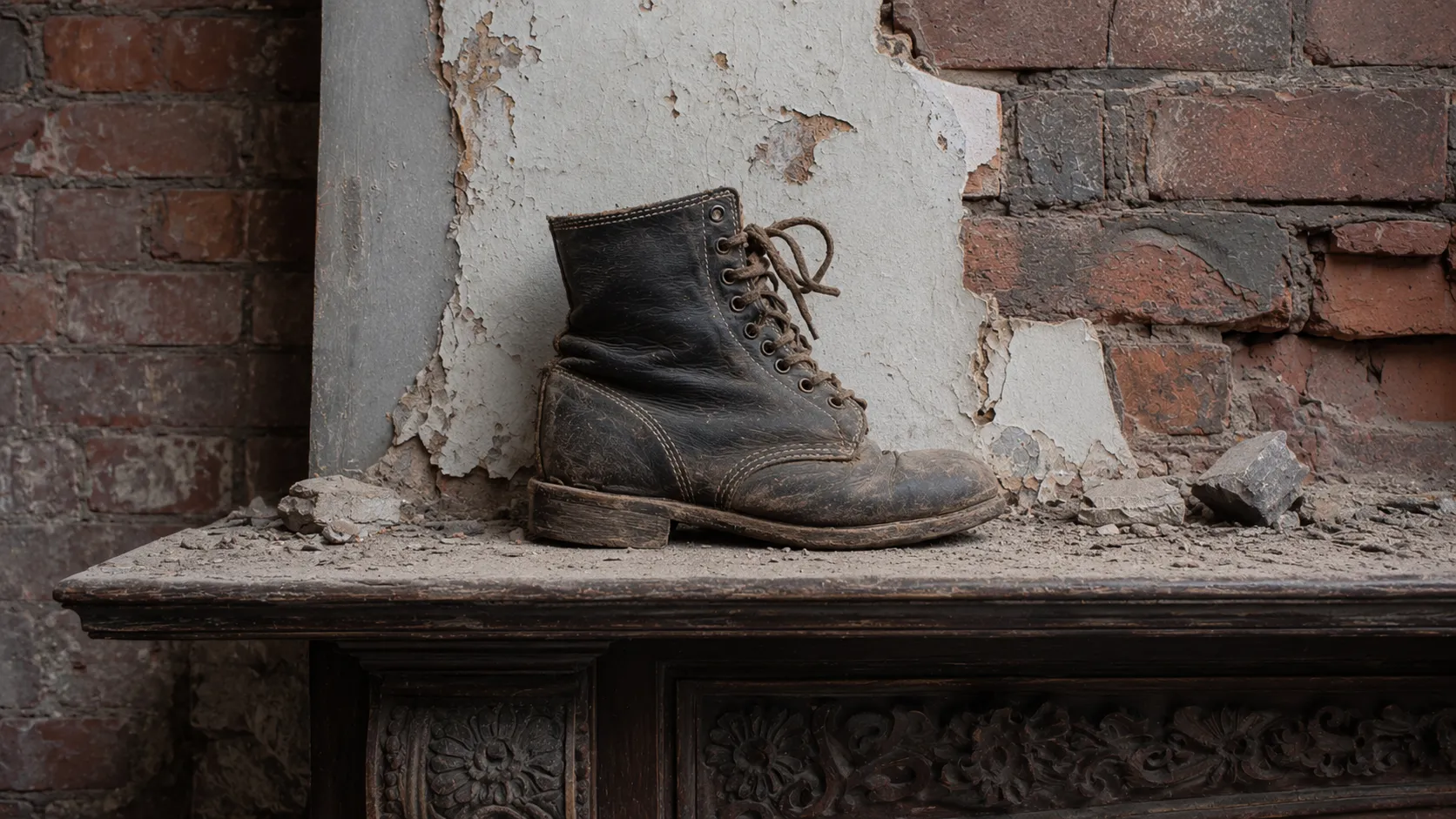
If you take an old English house apart, there is a reasonable chance you will find a shoe in it.
Not a pair. One shoe, worn out, often repaired, frequently a child’s. Bricked into the chimney breast, tucked under the hearth, laid on a joist above a ceiling, pushed into thatch, or — the case that settles the argument — plastered into a wall halfway up, where it cannot have arrived by accident.
This was done in England for at least five hundred years, in cottages and manor houses and public houses and a Benedictine monastery and a Baptist chapel. It was done thousands of times. Nobody involved ever explained it.
June Swann
The reason we know about it at all is a museum curator who noticed her own post.
June Swann joined Northampton Museum in 1950 and became Keeper of the Boot and Shoe Collection, in a town that made footwear. Around 1957, talking to John Thornton at the local technical college, she realised they had each independently been handed six or seven old shoes for identification, and that these had mostly come out of chimneys, and that this was too many for coincidence.
She could find nothing about it in print. So she started a card index.
That index — the Concealed Shoe Index — is still at Northampton and is the foundation of everything written on the subject since. It had over eleven hundred entries by 1998 and around nineteen hundred by 2012; other counts run higher, into the thousands of individual shoes from roughly two thousand locations. Almost half the finds date from the nineteenth century. There are reports from across Britain and from as far as Canada.
Swann was honest about its limits. The heavy concentration of Northamptonshire finds does not mean Northamptonshire did it more. It means the index was in Northampton and Swann talked to local groups.
The shoe that convinced her these were deliberate was an adult one, possibly from the 1620s, found set into the plaster of a wall at Leigh Barton in Devon. The one she could not stop thinking about was a pair of very small child’s boots in the thatch of a cottage at Stanwick, and the question of what sort of household lets a child that small lose its boots on the roof.
The pattern
The index gives numbers where folklore usually gives anecdotes, and the numbers are consistent.
Chimney, fireplace or hearth: about twenty-six per cent. Under the floor or above the ceiling: about twenty-three. In the roof: nearly as many again. Behind walls: about nineteen. Doorways and windows account for most of the rest.
Every one of those is a threshold. A hole in the envelope of the building — the places where something could get in, and the places where a house is not quite sealed against the outside. Archaeologists call the deposits left open and added to over time spiritual middens, as against a one-off concealment sealed behind plaster.
The shoes are almost always worn out and almost always single. Even after the mid-nineteenth century, when left and right shoes became properly distinguishable and a lone shoe was more obviously a lone shoe, people kept concealing them singly. More than a third — by some counts nearly half — are children’s.
And they rarely travel alone. The same voids turn up witch bottles, dried cats, horse skulls, written charms, hats, bodices, nails, thorns, dried hearts, tobacco pipes, pages torn from Bibles, and wineglasses with the stems deliberately snapped. Almost everything deposited is broken, incomplete or used up.
The silence
Here is what makes this the strangest entry in the whole of English folk practice.
We have a great deal of writing about English magic. Charms were published. Cunning folk advertised. Witch trials generated transcripts. Antiquarians collected. And on the single most widespread domestic magical act in the country — thousands of instances, five centuries, every social class — there is essentially nothing. No manual. No confession. No parish complaint. No diary entry saying put the boy’s old boot in the chimney today.
The theories are all reconstructions after the fact. That witches were drawn to the human smell that soaks into worn leather, got into the shoe and then could not turn round to get out. That it protected against the evil eye. That it came down from John Schorne, the fourteenth-century rector of North Marston in Buckinghamshire, who was supposed to have trapped the devil in a boot. These are plausible. None of them is attested by anyone who actually did it.
I think the silence is the finding, not a gap in the record. Some things are not written down because they are secret. Others are not written down because nobody thinks they are worth mentioning — because everybody knows, because you just do it, because it is what you do when the builders are in. This looks like the second kind. It is a habit rather than a belief, and habits are exactly what the written record misses.
Not quite over
It did fade through the twentieth century. It did not entirely stop.
The Norvic shoe company deliberately laid a pair of women’s boots in the foundations of its new factory in 1964. At Knebworth House, when an old court shoe turned up behind panelling, it was replaced with a shoe belonging to one of the estate workers, so as not to break the custom.
Which points at the other consistent thread in the whole business: it has always been considered unlucky to take one out. Builders find them, and put them back, and could not necessarily tell you why. Museums receive them, and there is a small body of anecdote about houses that became unsettled after a shoe left and settled down when it returned, which I offer as folklore about folklore rather than as evidence of anything.
If you own an old house and you find one, the received advice is the received advice. Put it back where it was.
Sources
- June Swann's articles on concealed shoes and the Northampton Museum Concealed Shoe Index
- Brian Hoggard, Magical House Protection: The Archaeology of Counter-Witchcraft (2019)
- Northampton Museum and Art Gallery
- the Footwear Research Network
- apotropaios.co.uk