Folk Ways · Jul 2026
Cellophane
England invented a mourning ritual in about 1989 and nobody announced it
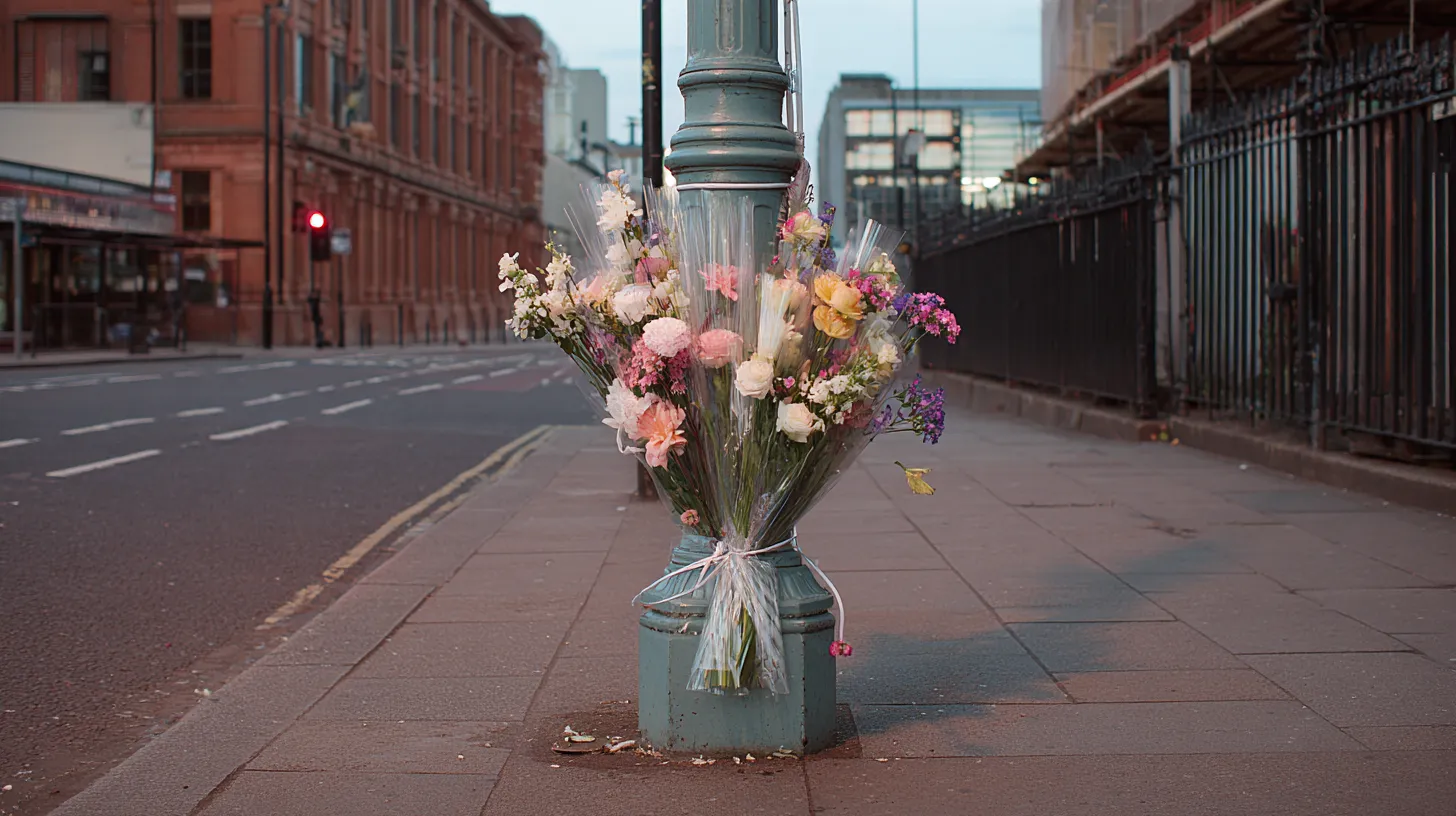
The most widely practised English ritual invented in the last fifty years is laying supermarket flowers, still wrapped, at a place where somebody died.
Nobody proposed it. There was no revival, no folklorist recording it in a village, no church behind it. It arrived, more or less fully formed, and it is now so ordinary that a lamp post with a bunch of chrysanthemums cable-tied to it needs no explanation at all.
The usual date given is 1997 and Kensington Palace, but the sociologist Tony Walter had already written it up six years earlier, from Anfield.
After Hillsborough in April 1989, people started arriving at the ground the next day. Within a week something like a million had passed through. They brought flowers, and scarves, and shirts, and tied them to the gates, and eventually the pitch itself was covered from the goalmouth outward. Walter used it at the time to argue against the then-fashionable idea that the English had lost their mourning rituals and made death taboo. The rituals were plainly there. They just were not in any of the places sociologists had been looking.
By 1997 the form was set: flowers, messages, soft toys, candles, left at a boundary rather than a grave. Walter later surveyed 147 towns and cities to find out where people had actually gone. In cities and villages it was often the church. Everywhere else it was the town hall, the war memorial, the shopping centre — wherever the community had something that functioned as a front door.
What strikes me is the cellophane. Every account of the older customs in these islands involves things being made: a wreath woven, a garland carried, something done by hand. This ritual runs entirely on a purchased object, unmodified, still in its wrapper with the price on. It has to, because the whole thing is improvised at short notice by people who are not related to the dead and have no standing to do anything else. The wrapping is the proof you did not plan it.
At Kensington Gardens the flowers rotted inside their plastic and there was a small national argument about what to do with them.
Five hundred years of English custom lies behind the horn dance and the corpse road. This is a custom that assembled itself inside a decade, in car parks and outside football grounds, from a product invented for garage forecourts. It is as folk as anything in the county archives, and the only reason it does not feel like folklore is that we watched it happen.
Sources
- Tony Walter, 'The Mourning After Hillsborough', The Sociological Review, 1991 — Anfield tributes; c.1 million visitors within a week; used to test the 'death is taboo' thesis
- Tony Walter (ed.), The Mourning for Diana (Berg, 1999) — Kensington Gardens as temporary cemetery, pilgrims and shrines, books of condolence
- Tony Walter, 'From cathedral to supermarket: mourning, silence and solidarity', The Sociological Review, 2001 — survey of 147 towns and cities on where flowers were laid; churches in cities and villages, town halls, war memorials, shops elsewhere
- Mass Observation Archive, 'Beneath the Mourning Veil: Mass-Observation and the Death of Diana'