Under Glass · May 2026
Caught by the River
A man spent nine months throwing a typeface off Hammersmith Bridge
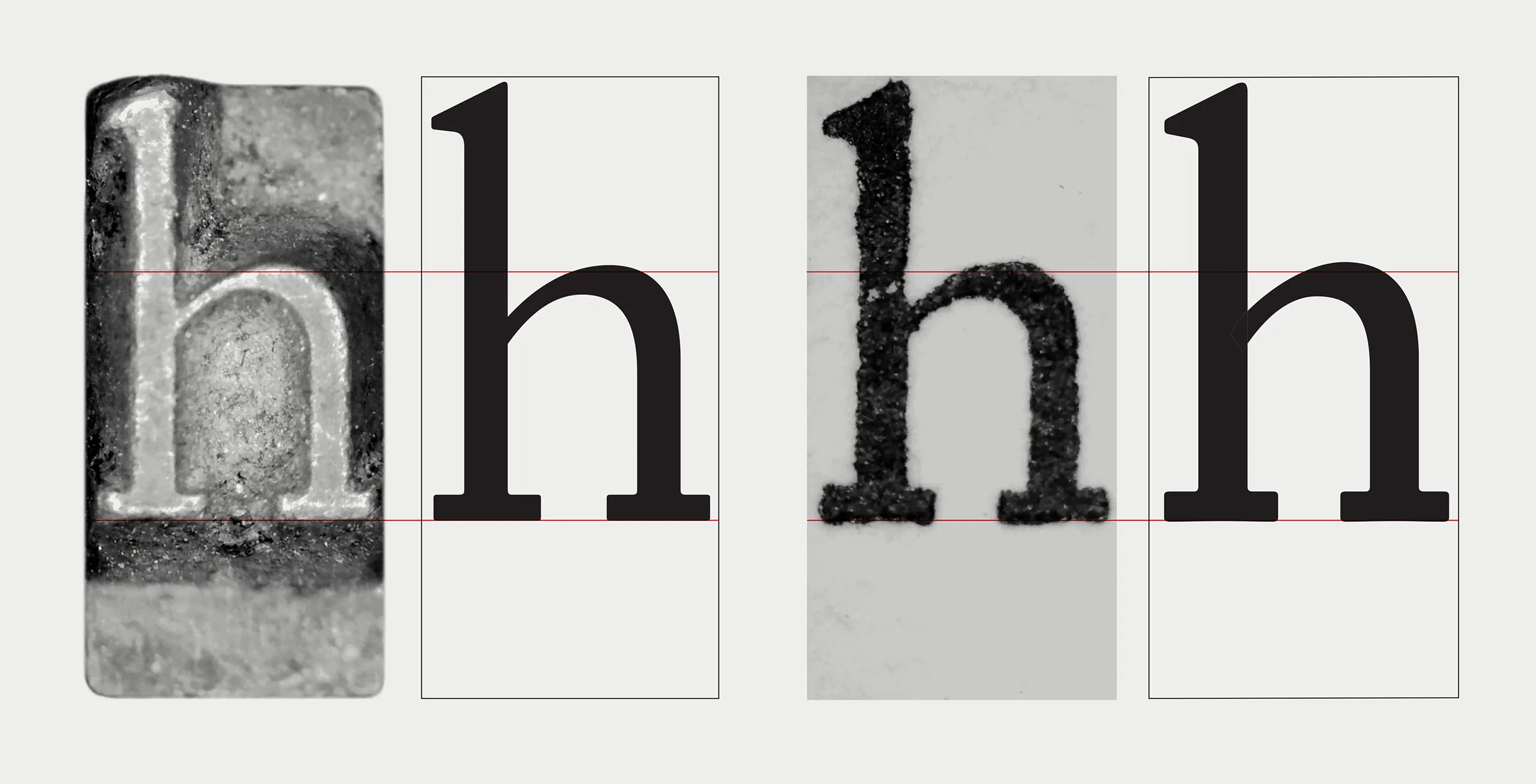
Image from TypeSpec.co.uk
Between August 1916 and January 1917, an ailing man in his late seventies walked from his house in Hammersmith to the bridge, roughly a hundred and seventy times, and dropped a parcel into the Thames.
The parcels were wrapped in paper and tied with string, weighing somewhere between twelve and twenty pounds each. He timed the drops to coincide with traffic crossing the timber deck, so the noise would cover the splash. Altogether he put about a ton of metal into the river.
The metal was a typeface. It was his.
The Doves Press
Thomas James Cobden-Sanderson was a bookbinder who came to printing late and took it extremely seriously. In 1900 he founded the Doves Press in Hammersmith with Emery Walker, naming it after the pub by the bridge.
Their type was cut for them alone. Walker and Cobden-Sanderson went back to Venetian models of the 1470s and had a face made that sat lighter on the page than its sources. No illustrations, no ornament, white vellum bindings with gold on the spine. Cobden-Sanderson’s phrase for what he was after was the Book Beautiful, and the five-volume Doves Bible, finished in 1905, is the thing everyone points at.
One detail matters more than any other for what happened next. The type was only ever cut in a single size, sixteen point. There was no family, no second weight, no smaller cut to fall back on. What existed was what existed.
The falling out
Walker was a practical printer. Cobden-Sanderson was not. The partnership was legally dissolved in 1909 after the business ran into difficulty, and the arrangement they reached was that the type would remain in use at the Doves Press during Cobden-Sanderson’s lifetime and pass to Walker after his death.
Cobden-Sanderson could not bear it. He had written that it was his wish the Doves type should never be subjected to any machine other than the human hand. Walker owning it meant Walker using it, and Walker using it meant it going somewhere he could not control.
He began with the punches and matrices – the tools from which fresh type is cast – on Good Friday 1913. Destroy those and the face cannot be reproduced, only spent. Three years later he started on the type itself.
In March 1917 he announced publicly that the Doves Press was closed and its type dedicated and consecrated to the Thames. Nobody took him literally. He had to write to his solicitor to explain that he was not speaking figuratively; the type was gone.
He kept a journal throughout, and recorded the dates and the places.
What he did not consider
Robert Green, a graphic designer, began work in 2010 on a digital facsimile, reconstructing the letterforms from printed pages – which is a poor way to do it, because ink spreads and paper distorts and you are always guessing at the shape of the metal from the mark it left. He released a version in 2013 and was not happy with it.
Then he read the journals.
In October 2014 he went down onto the foreshore at low tide at the spot Cobden-Sanderson had described, and within twenty minutes he had three pieces of type in his hand. He rang the Port of London Authority. A boat came up from Gravesend with divers, who went down with a bucket, dredged the riverbed and sorted the spoil through an ordinary kitchen sieve. After about ninety minutes, letters started appearing in the mesh.
They brought up a further hundred and forty-seven sorts – individual pieces of type – bringing the total to about a hundred and fifty. Green used them to correct his digital version against the actual metal.
He kept half and gave the other half to the Emery Walker Trust, which looks after Walker’s house as a museum. So a portion of the type Cobden-Sanderson destroyed specifically to keep from Emery Walker is now in Emery Walker’s front room.
The part I keep returning to
The story is usually told as a tale of magnificent spite, and it is, but the interesting failure is technical rather than moral.
Cobden-Sanderson understood that destroying the punches and matrices made the face unreproducible, and he was right. He understood that destroying the type made it unusable, and he was right about that too. What he did not account for was that the Thames is not a furnace. Lead does not dissolve. He chose a method of destruction that preserved the objects perfectly and merely mislaid them, and then he wrote down where.
A hundred and seventy round trips across a bridge at night, by a man in his late seventies, in wartime, to hide something he could have melted down in an afternoon. The ritual mattered more than the outcome. He was not disposing of the type. He was burying it.
And it worked, for ninety-eight years, which is longer than most people manage.
Green’s revival is now in general use. The headline cut was chosen for the architectural lettering on the Thames Tideway scheme – the deep sewer running under the river – which means the type is back in the Thames, at scale, cast in the infrastructure, permanently, and legible.
Sources
- Robert Green and Typespec on the Doves Type revival
- London Museum on the 2014 recovery
- Creative Review and Colossal interviews with Green
- the Emery Walker Trust
- Cobden-Sanderson's journals as quoted in the above