Field Notes · Apr 2026
A Brief History of Dead Hedgehogs
Four hundred years of killing them, and what the empty verges mean now
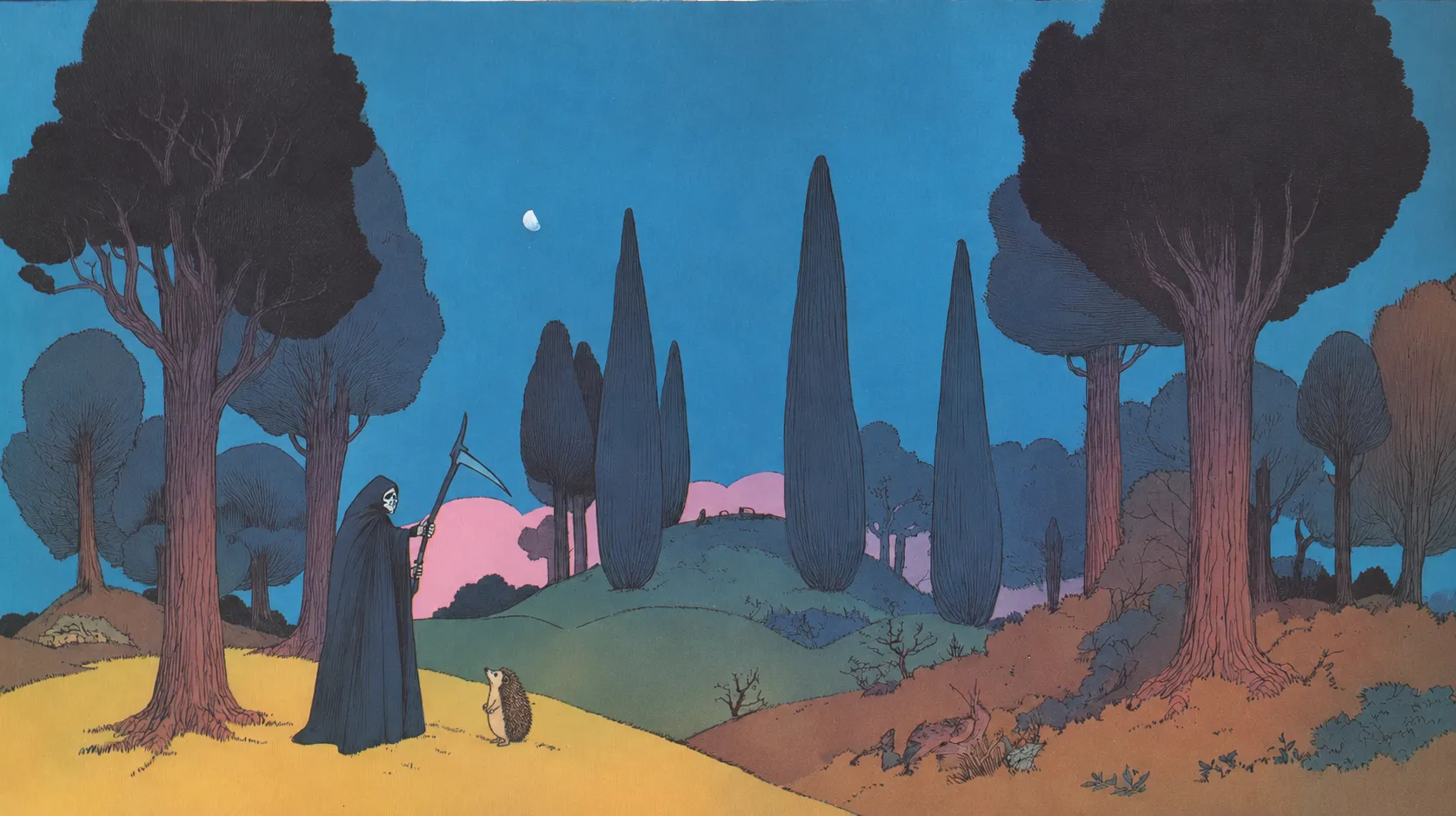
The English have been paying money for dead hedgehogs since 1566, and we have only recently stopped finding them.
Those two facts belong together, though not in the way you would expect.
Urchins
In the churchwardens’ accounts of English parishes, from the sixteenth century well into the eighteenth, you keep meeting a line item for urchins. Not children in rags. Hedgehogs – urchin was the ordinary English word for the animal, and the sea urchin got its name by resemblance, not the other way round.
The mechanism was statutory. Henry VIII’s Preservation of Grain Act of 1532, passed after a run of bad harvests, established the principle of a public bounty on creatures held to compete with human food. Elizabeth’s amending Act of 1566 widened the list enormously and moved the payments onto the churchwardens, so that the parish rate – the money for mending the church roof – also funded the killing of foxes, badgers, polecats, weasels, stoats, wildcats, otters, rats, moles and hedgehogs.
The hedgehog rate in 1566 was twopence a head. That is twice what the same Act offered for a wildcat. Some parishes later paid up to fourpence.
Roger Lovegrove went through the surviving churchwardens’ accounts of around 1,429 English and Welsh parishes for his book Silent Fields – roughly a fourteen per cent sample of what once existed – and found bounties paid for something in the order of half a million hedgehogs in the late seventeenth and early eighteenth centuries alone. Scale that up and the real figure over the life of the Acts becomes very difficult to look at.
Why twopence
Because of the cows.
The belief, held firmly and for centuries, was that hedgehogs came into the field at night and took milk directly from the udders of sleeping cows. It is a specific accusation, and to a smallholder with one or two animals it was a serious one. Hedgehogs were also thought to steal eggs, which was nearer the truth, and to be generally up to something.
Lovegrove makes an observation about this that I have not been able to shake: before electric light, people simply had no way of knowing what happened outdoors after dark. What the animals did at night was a matter of report and inference. A creature that came out only in the dark, made a noise in the grass, and was found in the morning near the cows was convicted on all available evidence.
The hedgehog had form in the imagination anyway. Pliny records that they roll on fallen apples to spike them onto their backs and carry them home to hollow trees, and the medieval bestiaries drew it that way for a thousand years – hedgehogs trundling about wearing their groceries. They do not do this. But a beast that steals fruit by an ingenious method is a beast you can believe steals milk.
The modern coda is neat. Hedgehogs are lactose intolerant. Milk makes them ill, which is why the standing advice is never to put a saucer of it out. The one thing four hundred years of English opinion was certain hedgehogs did is the one thing that harms them.
Counting the dead
The bounty acts were repealed in the eighteenth century, once the destruction became visible enough to trouble people. The hedgehog then had its long and comfortable spell as a garden favourite, a Beatrix Potter washerwoman, the least controversial animal in the country.
And now the numbers.
Anyone quoting a figure of thirty million hedgehogs in 1950s Britain should say plainly that it was a guess, made by extrapolating from small samples with no proper census behind it. It has been repeated so often that it has hardened into a baseline it was never fit to be. A recalculation in the 1990s put the population around 1.5 million. The most recent national review, in 2018, gives about 879,000 across Britain, roughly a quarter of them urban.
The trend is not in doubt even where the absolute numbers are. Rural hedgehogs have fallen by something between a third and three quarters since 2000, with the east of England worst hit; the annual rate of rural decline has run at around eight per cent. Urban populations have levelled off and may be creeping up, which means the hedgehog is now, oddly, a town animal being pushed out of the countryside. It sits as Vulnerable on Britain’s red list of mammals, and Near Threatened globally.
Roads kill somewhere between 167,000 and 335,000 hedgehogs a year in Britain. Recent modelling from Nottingham Trent suggests that in a population of fewer than fifteen animals, one or two road deaths a year cannot be bred back, and the local population is finished within a decade. Most of the hedgehogs killed on roads are male, which slows the damage in big populations and does nothing at all for small ones.
The thing about not seeing them
Here is the fact this whole piece was written to arrive at.
Over the past twenty years, the number of hedgehogs recorded dead on British roads has gone down. Traffic has gone up.
That is not a safety improvement. Roadkill counts are one of the few long-running measures we have of how many hedgehogs are out there, and they are falling because there are fewer hedgehogs to be hit. The verge is clearing because the fields are empty.
Which produces the peculiar position we are now in. For four centuries an English parish could look at a dead hedgehog and see twopence. For most of the last century we looked at one and felt sorry. And now the correct response to seeing a dead hedgehog on the A-road is something closer to relief, because it means there was a live one there this morning.
Larkin wrote a poem about killing a hedgehog with a mower and being unable to get past it. That is the usual register for this animal, and it is not wrong. But the useful grief is statistical and it points the other way: not at the one you saw, at all the ones you didn’t.
You can cut a thirteen-centimetre square hole in the bottom of your fence. It is the single most effective thing anybody has come up with, and it works because the animal’s real problem is that its world has been divided into pieces too small to live in.
Sources
- Roger Lovegrove, Silent Fields: The Long Decline of a Nation's Wildlife (OUP, 2007)
- Preservation of Grain Acts 1532 and 1566
- The State of Britain's Hedgehogs, PTES and British Hedgehog Preservation Society
- Mathews et al., A Review of the Population and Conservation Status of British Mammals (2018)
- Natural History Museum
- Moore et al. on roadkill and population viability, Nottingham Trent University
- Pliny, Natural History, book 8