Strange Ground · Aug 2026
Eight Tons of Poplar
The V&A bought a council flat
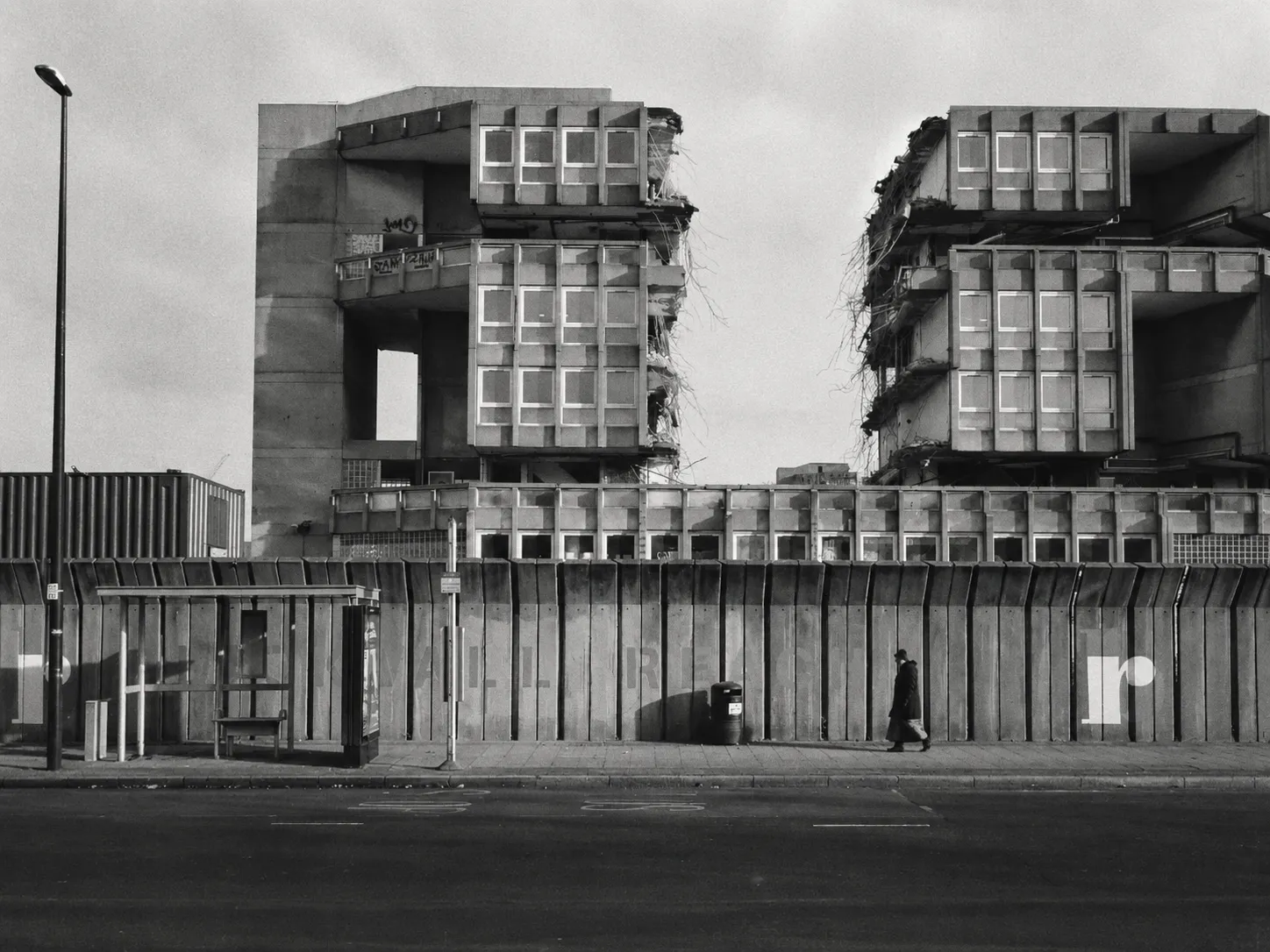
Photo by Joe Gilbert
“A building under assembly is a ruin in reverse.”
In December 2017 the Victoria and Albert Museum acquired part of a council estate. Not a drawing of one, or a model, or a photograph. A three-storey section of each façade of Robin Hood Gardens in Poplar, plus the interior fittings of two flats, cut out of the building while the demolition crews worked around them.
The estate was designed by Alison and Peter Smithson and completed in 1972: two long concrete slabs around a raised green, 252 homes, with wide external access decks the Smithsons called streets in the sky and intended as places where neighbours would meet. It was their only council estate and the culmination of twenty years of thinking about how people should live.
It was denied listing repeatedly. Building Design and the Twentieth Century Society ran a long campaign to save it, which failed. It is being replaced by Blackwall Reach, a redevelopment of around fifteen hundred homes, some of them marketed abroad as a high-yielding investment. Canary Wharf is a few hundred metres away and appears in every photograph of the demolition, framed by whatever hole the crane has just made.
The fragment went to the Venice Architecture Biennale in 2018 as the centrepiece of an exhibition called Robin Hood Gardens: A Ruin in Reverse. Eight tons of façade were reassembled outside the Applied Arts Pavilion on a scaffold engineered by Arup, who had engineered the original building. Visitors could climb up and stand on a genuine section of street in the sky.
The title came from the Smithsons themselves, who had brought Robin Hood Gardens to Venice once before, in 1976, as a billboard-sized photograph of the newly finished estate. A building under assembly, they wrote, is a ruin in reverse.
There is a sharper detail underneath all this. In 2008, asked to back the petition against demolition, the V&A declined. It acquired the fragment nine years later, once the outcome was settled, describing it as a small segment of a masterpiece.
Alison Smithson, before the thing was even finished, was complaining about vandalism and about tenants who she doubted would look after their rented bit of the socialist democratic dream.
So the object now in the national collection is a piece of housing that its architects distrusted the residents of, that the state refused to protect, that a museum would not campaign for and then collected, and that several hundred people had been living in until shortly beforehand.
They are not in the exhibition. Do Ho Suh filmed the empty interiors, and the film is extraordinary, and the flats in it have just been vacated.
Sources
- V&A, 'La Biennale di Venezia 2018' and Christopher Turner, 'A small segment of a masterpiece', V&A blog, March 2018 — acquisition details, 8 tons, Arup scaffold, Alison Smithson quotation
- Dezeen, 'V&A unveils huge section of demolished Robin Hood Gardens', May 2018
- Oxford Art Journal, 'Salvage Brutalism: Class, Culture and Dispossession in the V&A's Fragment of Robin Hood Gardens' — the critical counter-reading, and the 2008 refusal to back the Building Design petition
- Metropolis magazine on the Blackwall Reach redevelopment and its overseas marketing