Strange Ground · May 2026
Curated Decay
Orford Ness, and the Trust's decision not to preserve it
The National Trust exists to preserve things. At Orford Ness it has formally decided not to.
The Ness is a shingle spit off the Suffolk coast, reachable only by boat. The War Department took it in 1913 and it stayed secret through both wars and most of the Cold War. Between 1953 and 1966 the Atomic Weapons Research Establishment built six test cells there, in which British nuclear weapons were subjected to vibration, heat, cold, shock and G-force to see whether they would still work after being carried about. No fissile material was involved. The high explosive was real.
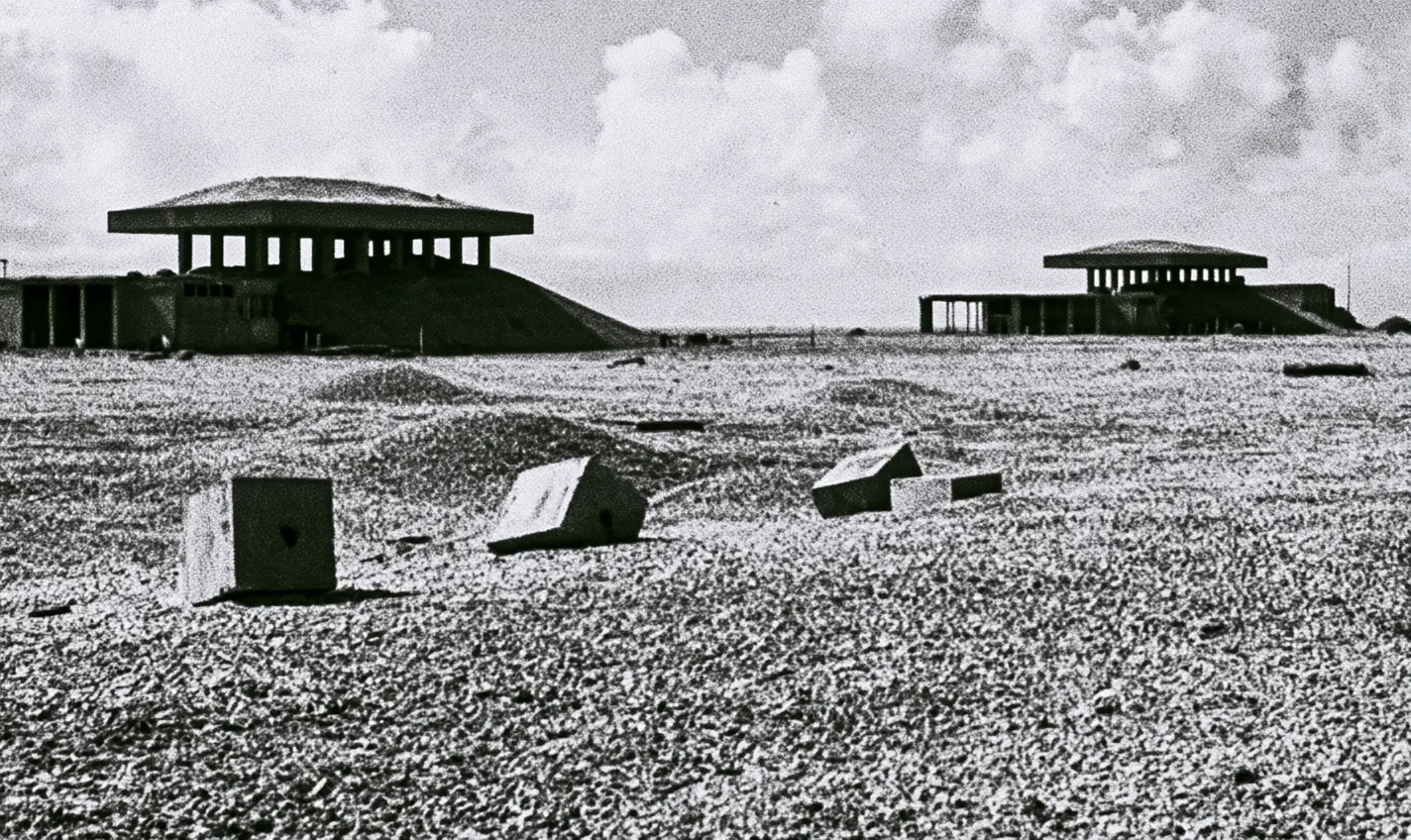
Two of those cells, built in 1960, are the pagodas: heavy concrete roofs on splayed columns, topped with shingle. The shape is not decorative. If a test went wrong, the roof was meant to lift, vent the blast upward, and then fall back and smother it.
The AWRE left in 1971. The Trust bought most of the site in 1993 and opened it to the public in 1995, principally because of the vegetated shingle, an internationally rare habitat of which the Ness holds a serious proportion.
And then it had to decide what to do with the buildings, and it decided to let them fall down.
The policy is called curated decay, or managed ruination. Historic England scheduled several of the structures as monuments in their already ruined state. The thing being protected is the ruin, not the building. So there is minimal intervention, neither to arrest the decay nor to hurry it. Some buildings were demolished as beyond authentic repair. The airfields were stripped of concrete and returned to marsh. Gulls nest on the pagoda roofs.
The Trust is watching the pagodas go, deliberately, and the sea will take them.
The concrete has now deteriorated to the point where the buildings are too dangerous for anyone to enter, staff included. So in 2023 the Trust surveyed them using a Boston Dynamics robot dog and a set of drones, working with Historic England and engineers from UCL — recording the ruin, now, at a distance nobody is allowed to close.
Sources
- National Trust, Orford Ness research pages — 'curated decay' policy; robotic survey with Historic England, BAM Nuttall and UCL Bartlett School of Sustainable Construction
- BBC News, 'Orford Ness: Robotic dog surveys ex Cold War site in National Trust first', 2023 — Boston Dynamics Spot; Russell Clement quotes on inaccessibility and eventual loss to the sea
- Countryfile, 'The remarkable reinvention of Orford Ness' — scheduling granted on already-derelict condition; NT purchase 1993, public access 1995
- Mark Piesing for BBC Future — managed ruination; buildings demolished as beyond 'authentic repair'; airfields returned to marshland
- Robert Macfarlane on Orford Ness; 'controlled ruination, allowing entropy its play'