Lost Signals · Aug 2026
Show's Over
The strange afterlife of Test Card F
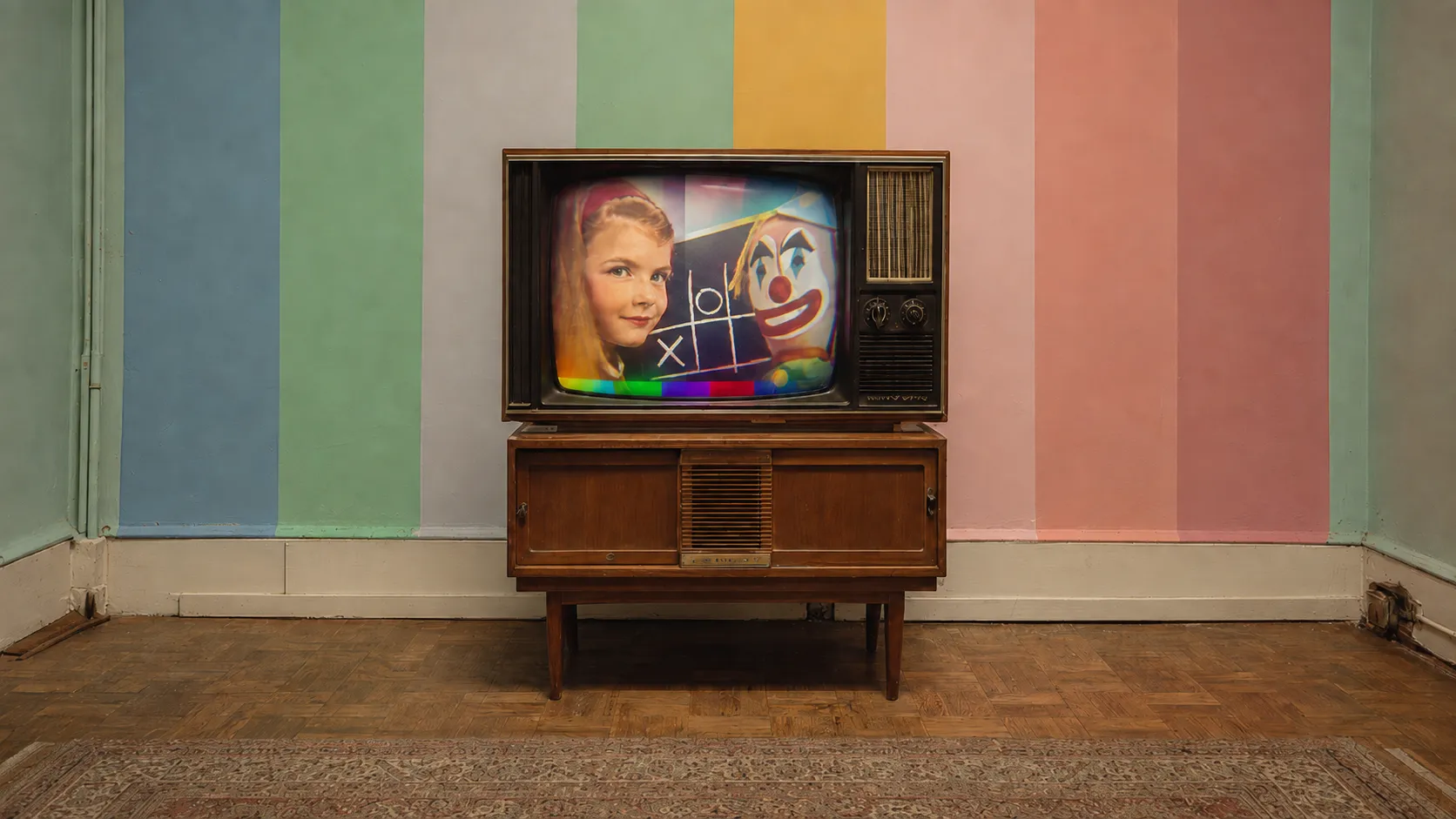
For thirty-one years, the most-broadcast image in Britain was a photograph of a girl who was not doing anything.
Carole Hersee was eight when the picture was taken, in her family’s house in Surrey, in a red hairband, sitting at a small blackboard with a game of noughts and crosses chalked on it and a soft clown propped beside her. She was paid £100. Her father George, a BBC engineer, was designing the corporation’s first colour test card and had begun by photographing Carole and her younger sister Gillian at home to show the committee what a child might look like on a calibration chart. Gillian had recently lost two front teeth. Carole got the job.
Test Card F went out on 2 July 1967, the day after colour reached the British public. By the time the BBC stopped using it – BBC One in November 1997, BBC Two in January 1999, both replaced by scrolling Ceefax – it had been on air for something like seventy thousand hours. No presenter, actor or newsreader has come close. The most-seen face in the history of British television belongs to a woman who went on to work in the wardrobe department at Shepperton, making costumes for Flash Gordon and Dangerous Liaisons, and who still has the clown.
Everything in the frame is doing a job
The pleasure of Test Card F is that it looks like a snapshot and is actually a precision instrument.
The girl is there because engineers needed a reference for skin tone, which is the colour the human eye is least willing to forgive. The blackboard is there for black level. The greyscales along the bottom are there to check that the set can tell eleven shades apart. And the X chalked in the left-centre square of the noughts and crosses grid is not a move in the game – it sits at the exact geometric centre of the screen, so that anyone lining up a picture could find the middle without measuring.
Someone noticed, late on, that Carole appeared to be left-handed. The transparency was flipped so the chalk would be in her right hand, which is why every English child who grew up with that image grew up with a mirror of a real afternoon.
The clown had a problem too. Bubbles was blue and white, and the picture had no green in it. So a green wrap was made for him. When the first version came back, the green was judged too subtle to be useful, and it was pushed louder. That is why the clown wears a colour nobody would have chosen for a clown.
The country used to close
The test card was only the most famous piece of a much larger silence.
Until February 1957, British television simply stopped for an hour each weekday evening, between six and seven. This was the Toddlers’ Truce, and it was exactly what it sounds like: with nothing on, small children could be got up the stairs and older ones might conceivably open a book. On Sundays the gap was longer and the reasoning was Reithian rather than domestic – television was not to give anyone an excuse to skip evensong.
The truce did not survive commercial television. ITV, funded by advertising rather than the licence fee, wanted that hour badly; the BBC, whose budget did not depend on how many hours it filled, was quite happy saving the money. The Postmaster General Charles Hill thought the whole thing patronising and ended it. The slot filled with news, which children found only fractionally more interesting than the blank screen.
Then there were the interludes. Live schedules ran ragged, and the BBC needed short films to lay across the joins: a windmill turning, horses ploughing a field, a white kitten, angelfish. The most-loved was the potter’s wheel, where a pair of hands – never a face – threw one vase after another and finished none of them. The oddest was London to Brighton in Four Minutes, in which a cameraman sat on the front of a locomotive hand-cranking a 35mm camera at two frames a second, producing an effective speed of about 765 miles an hour. When his film ran out he had to reload, and the missing stretches of Sussex were patched over with cutaways of the driver at the controls.
Closedown had its own liturgy. Tomorrow’s schedule, the weather, on some nights a public information film, an announcer wishing you goodnight and pointing you towards the radio, the clock, then the National Anthem over the ident. BBC Two never played the anthem. It faded to black and left you there.
What we lost when we stopped stopping
It is tempting to be sentimental about this and I would rather not be, because the actual interest lies elsewhere.
British broadcasting used to have a floor. The day had a bottom you could reach, and when you reached it the medium told you the truth about itself: this is a machine, it is being tuned, there is nothing here for you, go to bed. The test card was made to be looked at by engineers and was looked at by everybody. It was the only picture on television that was not trying to hold you.
Millions of people have a specific memory of waking on a sofa at three in the morning with Carole Hersee still there, still eight, still about to make a move she will never make. That image did more emotional work than anything it interrupted, and it did it by accident, being merely a chart.
Nothing closes now. The schedule is a ring road. Whatever else the test card was calibrating, it also calibrated the viewer, and the reading it gave was always the same, and always correct: that’s enough.
Sources
- BBC and Wikipedia records for Test Card F and Carole Hersee
- the Toddlers' Truce entry and BBC History Magazine
- the 405 Alive and Whirligig archives for interlude films
- Television closedown routines in the United Kingdom