Under Glass · Aug 2026
The Poster Nobody Saw
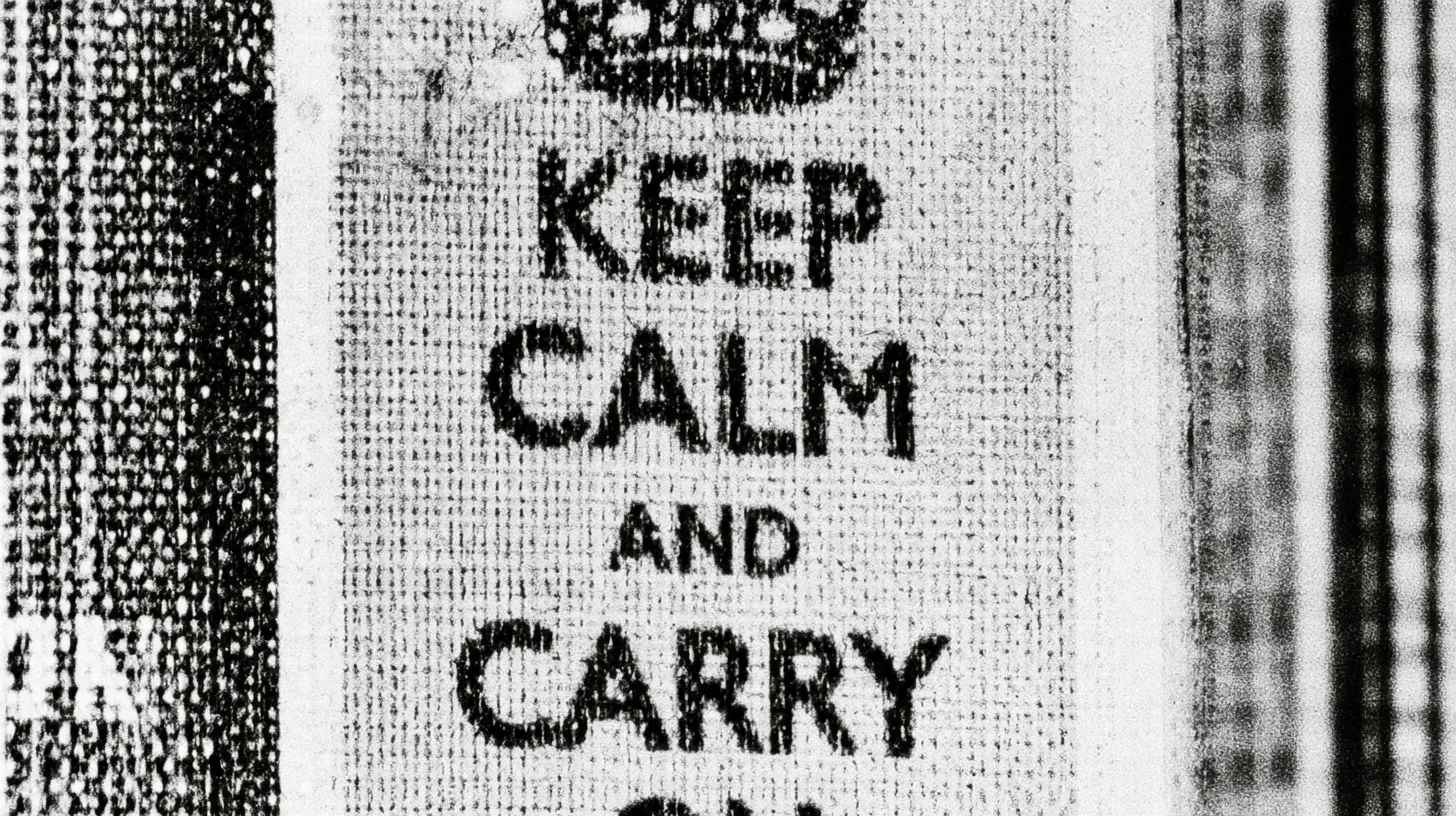
Keep Calm and Carry On, 1939 and 2000
The slogan was agreed at a meeting between the Ministry of Information and the Treasury on 27 June 1939, ten weeks before the war started.
It was the third of a set. The other two — Your Courage, Your Cheerfulness, Your Resolution Will Bring Us Victory, and Freedom Is In Peril, Defend It With All Your Might — went up everywhere the moment they came off the press, and were not much liked. People noticed that in the first one, your courage was going to bring us victory, and drew conclusions about who us was.
Keep Calm and Carry On was held back. Two and a half million copies, printed at a cost of around forty-five thousand pounds, sat in storage waiting for an invasion or a bombardment severe enough to justify them. The Blitz came and they were still not released; display was never authorised. In April 1940, the stocks went for pulping under the Paper Salvage campaign.
A handful got out. A Leeds shop had one up in October 1940, according to the Yorkshire Post. Cecil Beaton photographed a large one in a pub in 1941. A picture surfaced in 2016 showing one on the wall of a government laboratory in Bedfordshire. All unauthorised, all rare. The strict claim that nobody ever saw it is not quite true, but almost.
Then in 2000 a bookseller in Alnwick called Stuart Manley bought a box of old books at auction and found a folded sheet of paper at the bottom. He and his wife Mary framed it and hung it behind the till at Barter Books, which occupies a restored Victorian railway station.
Customers kept asking. They printed reproductions in 2001, and sold them slowly. The Guardian put it in a list of favourite things in December 2005 and they shifted nine thousand in a month. Fifty thousand by 2007. Then the financial crisis arrived in 2008 and the thing became inescapable — mugs, tea towels, cushions, an infinite generator of variants.
This is now the definitive image of British wartime character. It stands for understatement and steadiness, and it turned the stiff upper lip into a design object. And the generation whose character it supposedly documents never saw it. It was withheld from them, on the grounds that it was too bland to be worth issuing and possibly a little condescending, and then destroyed.
Sources
- Wikipedia, Keep Calm and Carry On — print run of 2.45m, retention until April 1940, Paper Salvage pulping, and the rare unauthorised displays
- The Conversation, 'Keep Calm and Carry On conquered the world, but it was too mundane for World War II' — the 27 June 1939 Ministry of Information/Treasury meeting; research by the Institute of English Studies and King's College London
- Bex Lewis, Keep Calm and Carry On: The Truth Behind the Poster
- Australian War Memorial blog and CNN Style on the Manleys, Barter Books and the sales trajectory
- Yorkshire Post, October 1940 (Leeds shop); Cecil Beaton photograph, 1941 (pub); photograph of a Bedfordshire government laboratory identified 2016