Lost Signals · Aug 2026
Swimming Lesson
The horror film the British government made for children
In 1973, the Central Office of Information commissioned a ninety-second film about drowning. What it got was a ghost story in which Death, played by Donald Pleasence, walks the banks of an English pond waiting for a child to make a mistake.
It went out between children’s programmes. It was never submitted to the BBFC, because it was not a film, it was information. It ran for most of a decade.
What happens in it
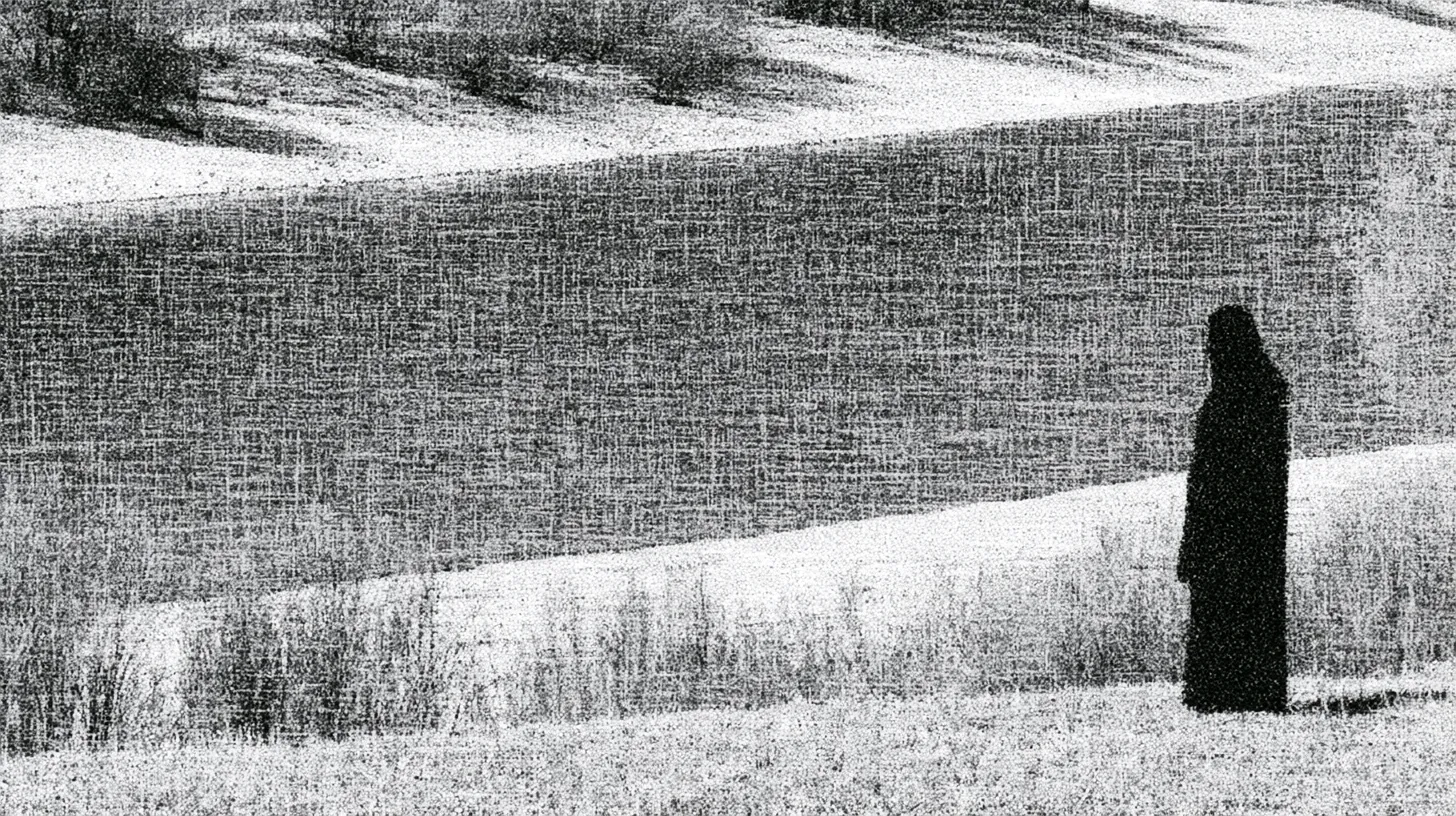
A camera tracks along a dark riverbank, mist on brown water, fallen branches. A hooded figure in a monk’s robe stands among the trees, face hidden.
The voice announces itself as the spirit of dark and lonely water, and says it is ready for the unwary, the show-off and the fool. It observes that this is the sort of place you would expect to find it. Then it says that nobody expects to find it in the next place, because the next place looks too ordinary.
Cut to four children messing about at the edge of a muddy pool, one of them reaching for a football with a stick. The voice notes that the pool is deep and the boy is showing off. The boy goes in.
It happens twice more. A boy fishing from a rotten branch. A boy swimming in a flooded place he should not be. Each time the figure watches, and the voice comments, with no obvious pleasure and no urgency whatsoever.
Then some sensible children pull the last boy out. The spirit says it has no power over them and vanishes, leaving the robe on the ground. A girl picks it up, says it is horrible, and throws it away.
The last thing on the soundtrack is Pleasence saying he will be back, with the word repeated into an echo until it fades.
Who made it
The script was by Christine Hermon, who also produced. Jeff Grant directed, for Illustra Films. It was commissioned because the number of British children drowning each year was considered unacceptable, and it was one of several water-safety films the COI put out around then – there was a Charley the cat animation on the same subject in the same year, in which a boy falls in a river and his father fishes him out.
Grant has said that when the script arrived he got a shock, and that the film set out to frighten. Terry Sue-Patt, one of the children in the film, went on to play Benny in Grange Hill.
Casting Pleasence was the decision that made it permanent. He was already a specific kind of English voice – quiet, precise, unhurried – and after Halloween in 1978 he became a horror fixture, which retrospectively recoloured a film that had been in circulation for five years by then.
Why it was allowed
The public information film in Britain in the seventies operated on the assumption that the audience was a population to be managed rather than a market to be pleased. The state had a measurable problem – children were dying in ponds – and access to television airtime, and no obligation to be liked.
So the film does not explain anything. It does not teach a skill, or offer a rule you could follow, or say what to do if you fall in. It does one thing, which is to attach a supernatural predator to a category of place, so that a child looking at a flooded gravel pit feels something before they think anything.
That is a folk method. It is the same instrument as the water spirits parents have used on children in every part of these islands – Jenny Greenteeth in Lancashire, Peg Powler on the Tees, the kelpie, all of them essentially a way of keeping small people away from deep water without having to watch them constantly. The bogey is not the departure. A government department commissioned one, on film stock, with a professional actor, and put it on the BBC.
Afterwards
It was voted the fourth most popular public information film in a BBC poll in 2006, and the highest-placed one-off. It made Channel 4’s list of scary moments in 2003. It comes up constantly whenever people who were English children in the seventies start comparing notes, usually with someone quoting the echo.
Whether it saved anyone is unknowable. The drowning figures did fall over the following decades, but road layouts changed, swimming teaching expanded, gravel pits got fenced, and no honest person can pull one film out of that.