Under Glass · Jul 2026
Myrninerest
Drawings made in an East Ham front room, signed by somebody else
Madge Gill made several thousand drawings and did not sign any of them with her own name.
They are signed Myrninerest, who was, as she explained it, a spirit — the one who arrived on 3 March 1920 when she was thirty-eight, and who stayed for the next forty-one years. The name is generally read as My Inner Rest.
Before
She was born Maude Eades in Walthamstow in 1882, illegitimate at a moment when that was a serious social fact. Her family kept her out of sight, and at nine she was put into a Barnardo’s home although her mother was alive. As a teenager she was shipped to Canada under the child migration schemes, and she came back to England as soon as she was old enough, at eighteen or nineteen.
She married her cousin, had children, and in the years around 1918 lost a son and the sight of one eye. In 1921, she gave birth to a stillborn daughter, and afterwards spent time under treatment in Hove, where somebody had the sense to tell her to keep drawing.
The work
She drew at night, by candlelight, extremely fast, on whatever was to hand.
Postcards, mostly — fifty to a hundred in one sitting, each one covered edge to edge in ink. Card. Cotton. And rolls of calico, unrolled across the floor of a house in East Ham and worked along their length, some of them thirty feet long. There is a photograph from August 1947 of her in the back garden at Plashet Grove hanging up a piece eleven metres by nearly two, because that was the only way to see the whole thing at once.
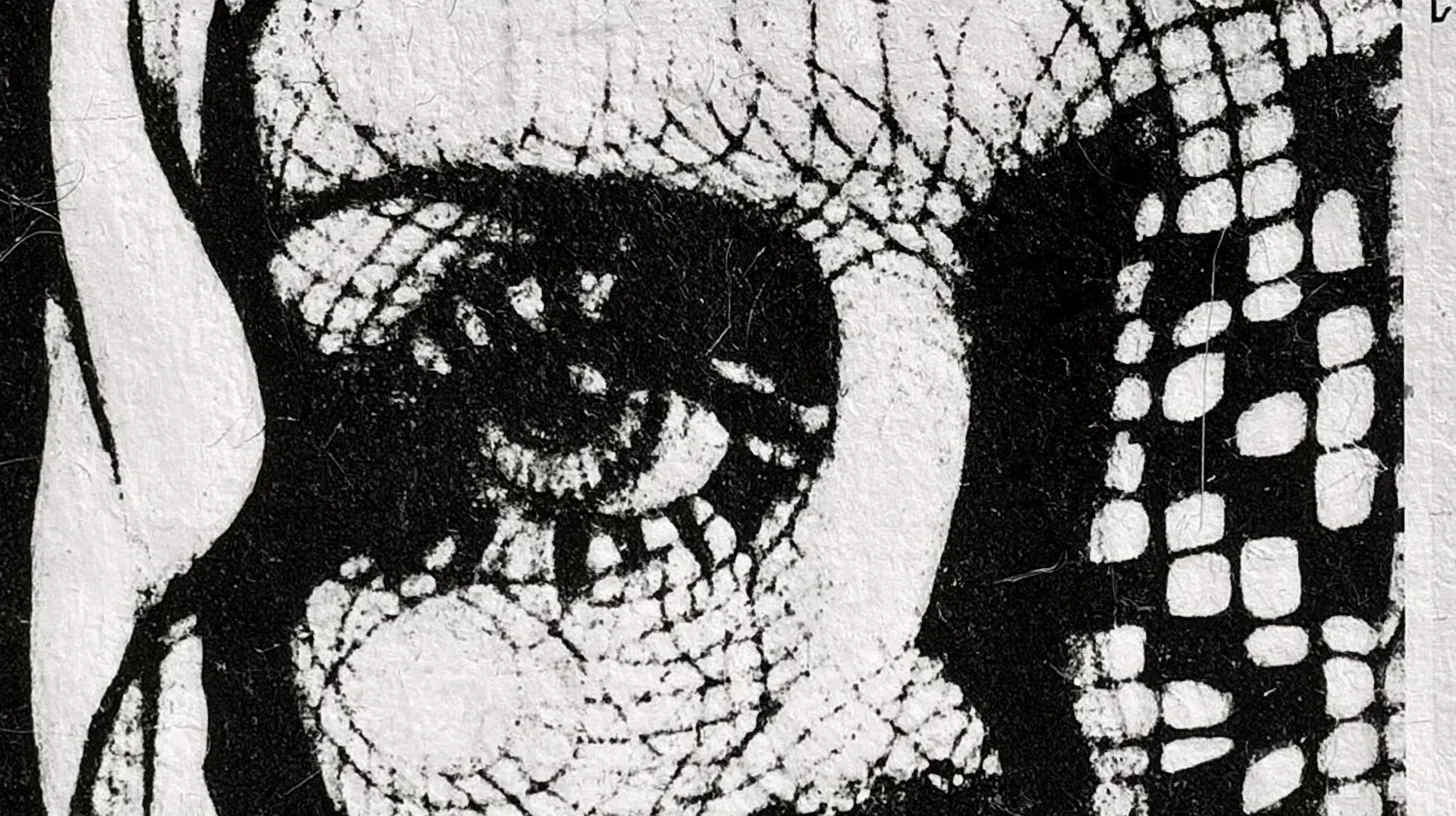
The surfaces are dense to the point of airlessness — repeating chequers, spirals, latticework, architectural forms that will not resolve. And through them, over and over, a young woman’s face: pointed chin, dark eyes, sometimes with a robe and a body, sometimes floating on its own.
She has never been identified. The candidates are the stillborn daughter, Myrninerest, and Gill herself, and there is no reason it cannot be all three.
She was self-taught and had no interest in being anything else. She said once that if she had been a man she would have gone abroad and studied botany.
Refusing to sell
She exhibited at the Whitechapel Gallery several times, and became locally known as a medium and an eccentric.
But she would not sell. Her position was straightforward and unshakeable: the work was not hers. Myrninerest had made it, and it was not hers to trade. Where she was pressed, she priced pieces so far beyond reach that nobody could take them.
So the drawings stayed in the house, and by the time she died in 1961 they were in every cupboard and under the bed.
Her son gave nearly two thousand of them to Newham Council, where they still are. At least as many again went out through house clearance and private sale and are now scattered across the world, in Lausanne and Lille and in collections that would not have existed in her lifetime. Some of the largest works are thought to have been thrown away.
Sources
- Wikipedia and East End Women's Museum — born Maude Ethel Eades, 19 January 1882, Walthamstow; illegitimate; sent to a Barnardo's orphanage at nine; sent to Canada as a teenager under the child migration schemes; returned at eighteen or nineteen; died 28 January 1961, Leytonstone
- Museum Crush, 'The art of Madge Gill and Myrninerest' — first contact with the spirit on 3 March 1920, aged 38; work made at night at speed, 50–100 postcards in a sitting
- Newham Heritage Month and The Line — ink and pencil on postcards, card and calico rolls up to 30 feet; a documented piece of 1.8 x 11 metres photographed in the garden at Plashet Grove, East Ham, in August 1947
- Exhibited several times at the Whitechapel Gallery; refused to sell, attributing the work to Myrninerest, and priced pieces deliberately beyond reach
- Nearly 2,000 works given to Newham Council by her son; at least 2,000 more dispersed by house clearance and sale. Held in the Collection de l'Art Brut, Lausanne, and l'Aracine at Lille. Retrospective at the William Morris Gallery, Walthamstow, 2019