Lost Signals · Jan 2025
Don't Call It Music
The BBC Radiophonic Workshop, 1958–1998
The BBC opened the Radiophonic Workshop on 1 April 1958, in two rooms at Maida Vale, with a budget of about two thousand pounds and a name chosen specifically so that nobody would have to call the output music.
Why it existed
By the mid-fifties the BBC’s radio drama producers, particularly on the Third Programme, wanted sounds that did not exist. Not effects in the old sense — a door, a horse, coconut shells — but atmospheres. The inside of a mind. A place that is not a place.
Two studio managers, Desmond Briscoe and Daphne Oram, had been improvising these on individual productions: Beckett’s All That Fall in January 1957, Giles Cooper’s The Disagreeable Oyster, Frederick Bradnum’s Private Dreams and Public Nightmares that October. They did it with tape — recording ordinary sound and then cutting, reversing, slowing, looping and layering it until it stopped being recognisable.
They lobbied for a permanent facility and got one. And the corporation, which had a Music Department with views about what music was and who was qualified to make it, avoided the argument by declining to have it. The unit would produce radiophonic sound. It sat under Drama, not under Music.
Radiophonic sound was not music, so it did not need composers, so the workshop was staffed with studio managers and engineers — people who understood tape machines rather than orchestras — and it was given a junk budget and told to get on with it.
The method
There were no synthesisers. For most of the first decade there was almost nothing you would recognise as a musical instrument.
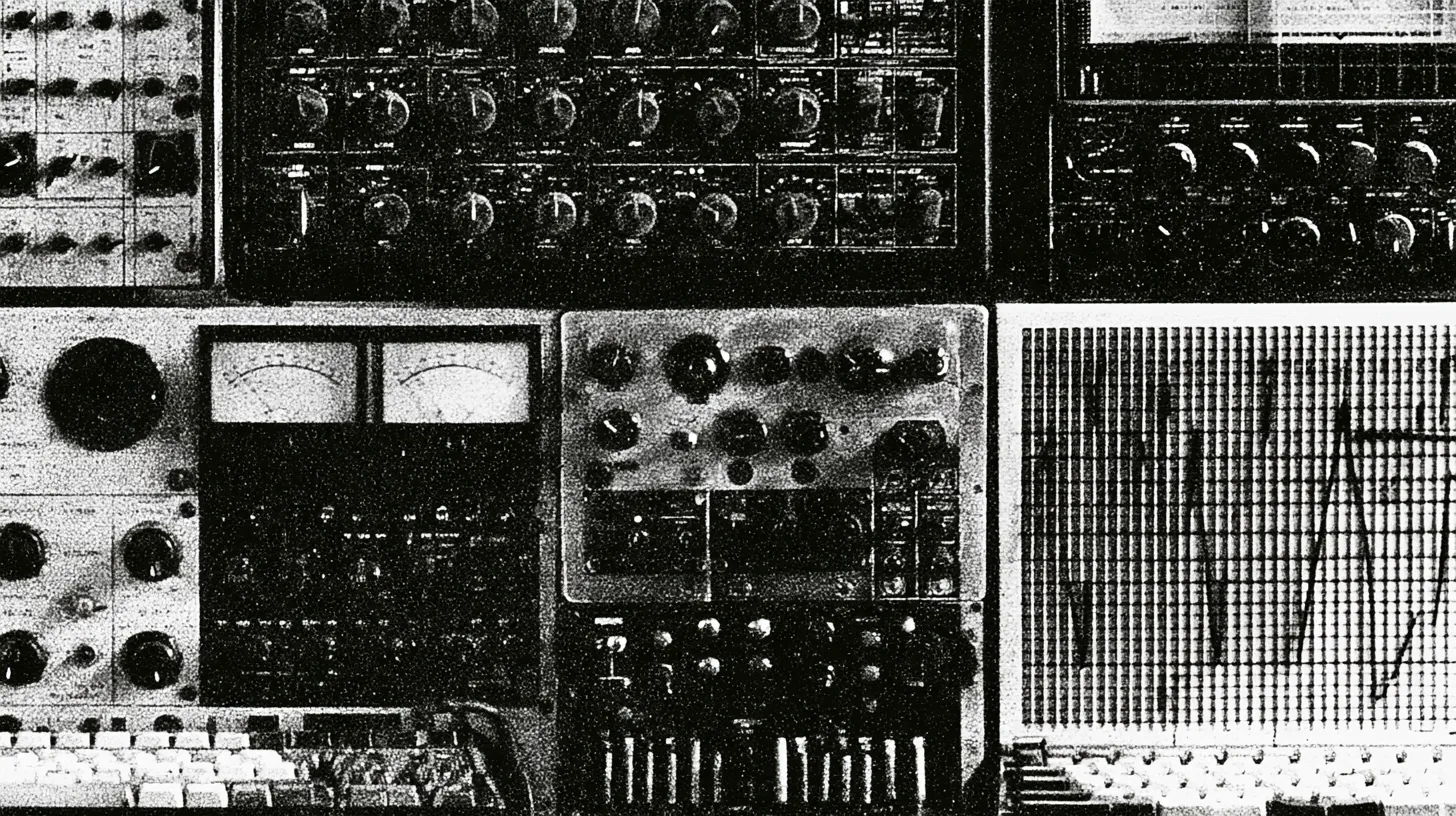
What there was: test-tone oscillators, tape machines, razor blades, splicing tape, and the contents of the BBC’s junk room. Things were retrieved from skips and bins because they made an interesting noise when struck. Delia Derbyshire’s green metal lampshade, which she hit and recorded, is now in the Science Museum Group collection.
To produce a note of a given pitch you recorded a sound and then adjusted the tape speed until it was right. To produce a melody you cut each of those notes out of the tape with a blade and joined them together in order, by hand, with the lengths of tape between them determining the rhythm. To produce harmony you ran several such tapes at once and hoped the machines stayed in sync.
The theme
In 1963 Ron Grainer wrote a theme for a new children’s science fiction serial. It was a page of manuscript with a melody, a bassline and some annotations that were less instructions than hopes — clouds, wind bubbles, that sort of thing.
Delia Derbyshire realised it. She was a Cambridge graduate in mathematics and music who had, by her own account, been turned down by Decca on the grounds that they did not employ women in their studios, had joined the BBC in 1960 as a trainee studio manager and moved into the Workshop in 1962.
Every element of the Doctor Who theme was assembled from individual pieces of tape. The bassline was plucked from a single string and cut note by note. The swooping upper line came from oscillators, hand-tuned. It was mixed by running the tapes in parallel.
It has been on British television, in one arrangement or another, for over sixty years, and it was the first electronic theme tune anybody in Britain had heard.
Grainer, hearing it, could barely believe he had written it, and tried to get Derbyshire a co-composer credit and a share of the royalties. The BBC refused, because staff members were not credited. She was staff. Her name was not on it.
The three-month problem
There is a story, told often enough that it has become part of the Workshop’s mythology and remains difficult to pin down in the paperwork, that the BBC originally intended attachments to the unit to last only three months, on the grounds that prolonged exposure to this kind of work was not good for people.
Whether or not that specific rationale was ever written down, the tenure policy was real, and the effect was real: the Workshop was not designed to build careers. Daphne Oram, who had co-founded it, left within about a year, frustrated by the lack of support. She went off and invented Oramics, a system for drawing sound onto film, and built her own studio, and is now regarded as one of the founding figures of electronic music in Europe.
The end
The equipment caught up eventually. Once a producer could hire a composer with a synthesiser and a sampler, the case for a specialist department maintaining tape machines and oscillators became difficult to argue in front of an accountant.
Work was being outsourced from 1995. Elizabeth Parker handed her key back to the Maida Vale caretaker in 1996. The Workshop formally closed in March 1998, after forty years.
Mark Ayres was given about three thousand reels of tape and set about preserving them, which is why any of it survives.
Derbyshire had stopped making music for years and started again late, working with Pete Kember of Spacemen 3. She died in 2001, the year before the compilations came out that made her, retrospectively and posthumously, famous.
Sources
- Wikipedia and Grokipedia, BBC Radiophonic Workshop — founded 1 April 1958, Rooms 13 and 14, Maida Vale Studios; initial budget c.£2,000; closed March 1998, work outsourced from 1995
- National Science and Media Museum, 'Birth of the Radiophonic Workshop' — junk-sourced equipment; Derbyshire's lampshade in the Science Museum Group collection; Grainer's 'clouds' and 'wind bubbles'
- Red Bull Music Academy Daily, 'Back To The Future: The Continuing Legacy of the BBC Radiophonic Workshop' — Oram's departure, Elizabeth Parker returning her key in 1996, Mark Ayres and the 3,000 reels
- Wikipedia, Desmond Briscoe — All That Fall (13 January 1957), The Disagreeable Oyster, Private Dreams and Public Nightmares (7 October 1957); Quatermass and the Pit
- Louis Niebur, Special Sound: The Creation and Legacy of the BBC Radiophonic Workshop (OUP, 2010)