Strange Ground · Oct 2024
Miles of Warning
The concrete ears at Denge, and a technology overtaken mid-build
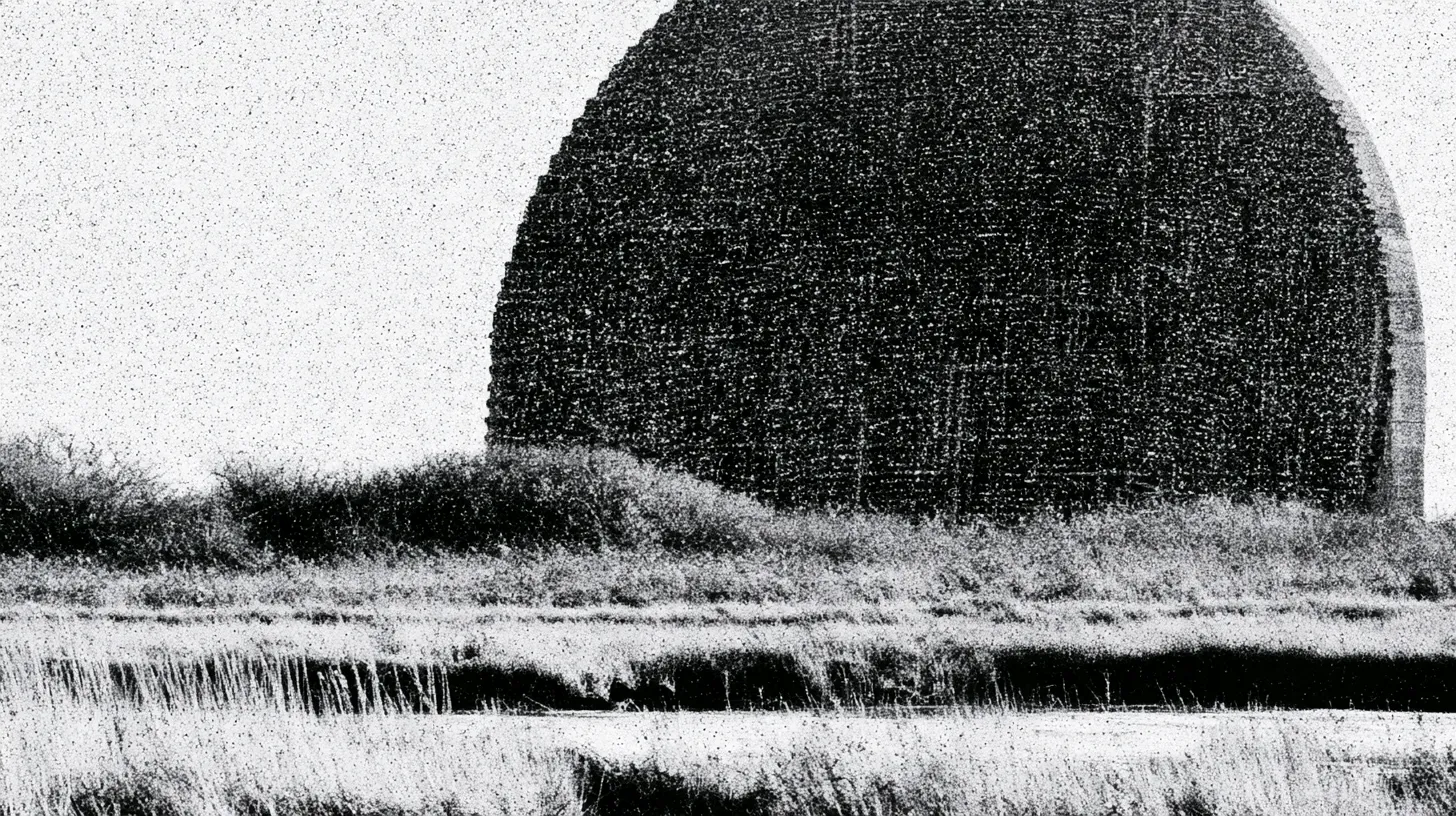
On an island in a flooded gravel pit near Greatstone, between the shingle of the Kent coast and the runway at Lydd, there are three concrete structures with no obvious purpose. A bowl about twenty feet across. A larger bowl, thirty feet. And a wall two hundred feet long and thirty high, slightly curved, standing on end in the middle of a marsh.
They were built to hear France.
The principle
The idea came out of the First World War, when it was noticed that you could hear an aeroplane engine some time before you could see the aeroplane. If you could work out where the sound was coming from, you had warning.
William Sansome Tucker, a physicist at the Air Ministry, spent from about 1916 to the mid-thirties developing the apparatus. A concrete reflector focuses incoming sound onto a point; put a microphone at the focus and you amplify a distant engine out of the general noise of the world. Move the microphone and you can work out the bearing. Link several stations and you can plot a course.
Denge is the reason the site matters, because it holds all three generations in one place: the small dish, the large dish and the great wall, which was the most sophisticated version and exists in only one other place on earth, in Malta. Other mirrors survive at Hythe, at Warden Point, near Dover, and up the north-east coast at Redcar, Sunderland, Seaham and Hartlepool.
The Denge structures went up in the late twenties and early thirties. A two-storey concrete listening room was added at the base of the two-hundred-foot wall in 1933.
Why it did not work
It did work, technically. The mirrors could detect an aircraft before it was visible.
The trouble was arithmetic. Useful range was under twenty-five miles. In 1918, that was a comfortable margin. By the early thirties aircraft were fast enough that twenty-five miles was not enough time to get fighters up and pointed in the right direction, and the margin was closing every year as engines improved. You cannot outrun the problem by building a bigger dish, because the aeroplane will always get faster than the concrete.
There were also nuisances of a very English kind. Operators struggled to tell aircraft from ships. Greatstone and Lydd-on-Sea were being built up as residential districts through the thirties, and the resulting noise degraded the readings so badly that by 1935 there were proposals to abandon the site and start again at Dungeness. In 1937, the Southern Railway realigned its branch line to New Romney and made things worse still.
And then, in 1935, the first practical radar trials were carried out at Orford Ness in Suffolk. That was the end of it. Plans for a chain of mirrors across the Thames Estuary were abandoned the same year in view of the possible development of alternative methods of detection. The two-hundred-foot mirror at Greatstone closed in 1937.
In 1939, the General Staff issued instructions to destroy the six Kentish mirrors. Nobody got round to it.
What survived was the method
The mirrors are usually described as a dead end, and as objects they are. But the acoustic programme had spent nearly twenty years solving a problem that turned out to be the harder half of the job: how to run a line of detection stations, get their separate readings back to one room, and turn them into a single plotted track of an aircraft moving across a map in something close to real time.
Radar replaced the sensor. It did not replace the system. The plotting and reporting arrangement developed for the sound mirrors was handed to the radar people and became the spine of Chain Home.
Now
Gravel extraction eventually surrounded the site with water. The mirrors sit on an island reached by a swing bridge that is kept locked open, which has solved the vandalism problem more thoroughly than any fence. The land is an RSPB reserve and the structures are scheduled monuments; the only way to stand in front of them is on one of the open days.
You can see them from the footpath along the east side of the lake, which is how most people do.
Tacita Dean made a film about them. Turin Brakes put them on record sleeves.
There is a working model at Hythe, half an hour up the coast, which two people can stand at either end of and talk through.