Strange Ground · May 2026
No Jurisdiction
Sealand, and a country founded on a boundary that later moved
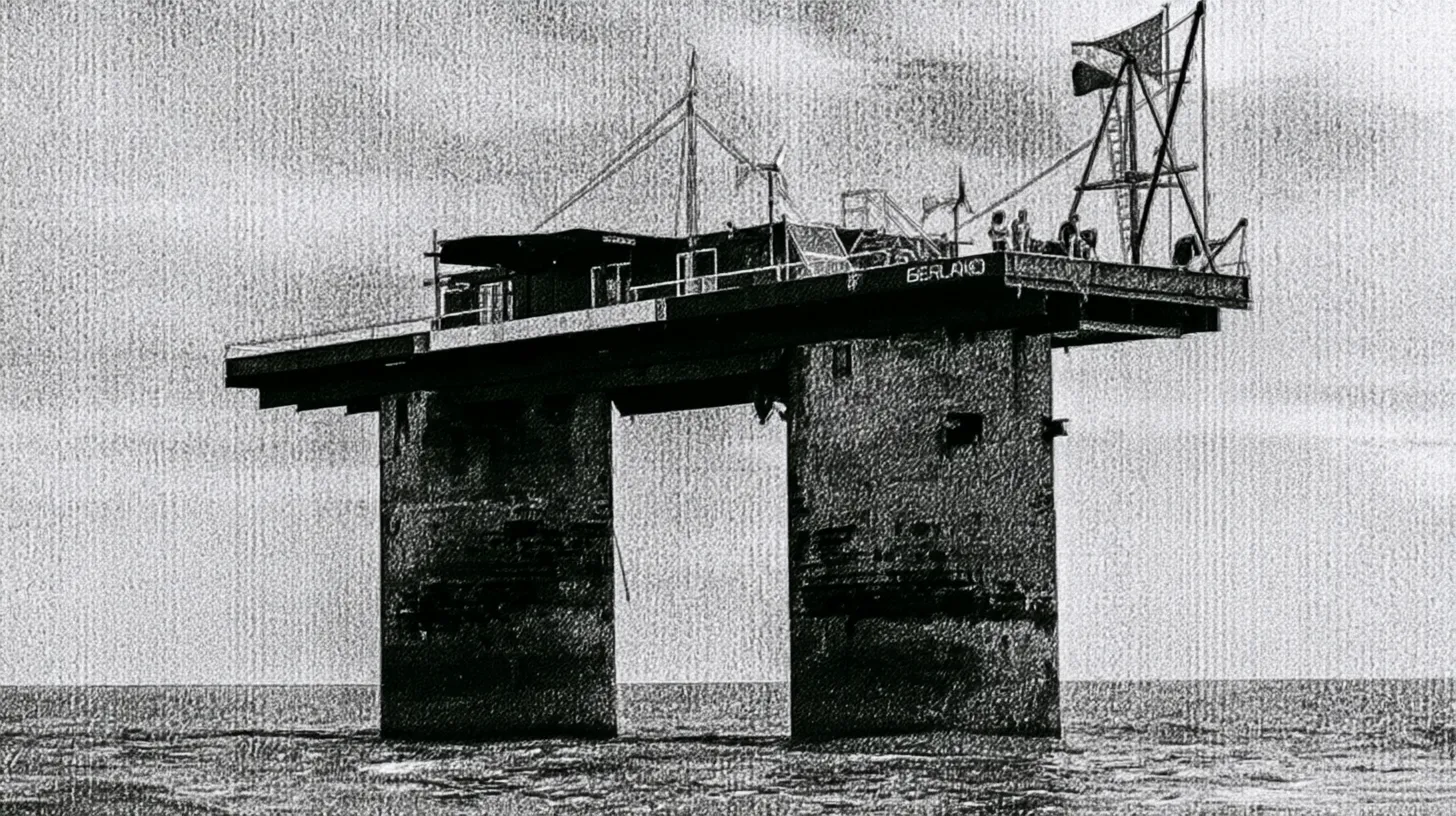
Six and a half nautical miles off the Suffolk coast there is a concrete and steel platform in the North Sea, and a family from Essex has been claiming it as a sovereign state since 1967.
The claim is usually treated as a joke. It is also, in one narrow and rather beautiful respect, better founded in English law than most people realise.
The fort
HM Fort Roughs was built in 1943, one of the Maunsell forts: towers constructed in dry dock, towed out and sunk onto a sandbank to shoot at German mine-laying aircraft. It was garrisoned by between a hundred and fifty and three hundred Royal Navy personnel through the war.
The last full-time crew came off in 1956. Trinity House marked it as a shipping hazard and everyone stopped thinking about it.
British territorial waters extended three nautical miles from the coast at the time. Roughs Tower was sunk at six and a half.
Pirates
In the mid-sixties the abandoned forts in the Thames estuary and off Suffolk filled up with pirate radio stations, which needed to be outside British jurisdiction and had just been handed a set of purpose-built platforms that were exactly that.
Paddy Roy Bates was a former army major running a station called Radio Essex from a different fort. It was prosecuted and closed in December 1966 — that one turned out to be inside the three-mile limit.
In June 1967, he fought a rival crew associated with Radio Caroline for control of Roughs Tower, and in September he took it, ejected them, and declared it the Principality of Sealand, with himself as Prince Roy and his wife as Princess Joan. He never actually broadcast from it.
Constitution, flag, anthem, currency bearing Joan’s face, passports, stamps. Motto: E Mare Libertas.
The ruling
Everything rests on 1968.
British workmen came out to service a navigational buoy near the platform. Michael Bates, Roy’s teenage son, fired warning shots to see them off. Bates was a British subject, so he was summoned to Chelmsford on firearms charges.
On 25 November 1968 the court held that it could not hear the case, because the events had taken place outside British territorial waters and it therefore had no jurisdiction.
That is all the ruling says. It is a finding about the geographical reach of an English criminal court, not a recognition of anything. But it is a real English court declining to apply English law to something a British subject did on that platform, and it is a considerably better legal artefact than any other micronation on earth possesses.
The war
In August 1978, while Roy and Joan were away, a German lawyer named Alexander Achenbach — who described himself as Sealand’s prime minister and held a Sealand passport — hired German and Dutch mercenaries and took the fort by speedboat and helicopter. They held Michael Bates hostage.
Roy retook it. The account given by Sealand is that he came in at dawn in a helicopter flown by a stunt pilot who had worked on the Bond films, and that the occupiers surrendered.
He then charged one of them with treason against Sealand, on the basis that a man holding a Sealand passport owed it allegiance, and held him.
The Netherlands and Germany asked Britain to intervene. Britain declined, citing the 1968 judgment. So the German government sent a diplomat out from its London embassy to the platform to negotiate, and after some weeks Bates let the man go.
Sealand has cited that visit as de facto recognition by Germany ever since. It is not, in any technical sense. But a sovereign state did send an accredited official to negotiate the release of its citizen with a man on a tower, and declined to treat the matter as an ordinary hostage-taking.
The boundary moves
And then, in 1987, the United Kingdom extended its territorial waters from three nautical miles to twelve.
Roughs Tower is six and a half miles out.
Since 1987, the platform on which the Principality of Sealand stands has been inside British territory, and the ruling on which the whole claim depends was a ruling about a line that no longer runs where it ran. There is a further difficulty: the modern law of the sea is explicit that artificial installations have no territorial sea of their own and do not affect anybody else’s boundaries. A platform is not an island.
Nobody has done anything about it. The fort caught fire in 2006 and was repaired, Roy died in 2012, Michael lives in Suffolk, and the passports are still issued.
Sources
- Wikipedia and HandWiki, Principality of Sealand — HM Fort Roughs built 1943 as a Maunsell fort, garrisoned by 150–300 Royal Navy personnel, last full-time personnel removed 1956; occupied by Paddy Roy Bates 2 September 1967
- Chelmsford Crown Court ruling, 25 November 1968 — no jurisdiction, the platform being outside British territorial waters
- Offshore Radio Museum, 'Sealand' — the Battle of Roughs Tower with Radio Caroline, June 1967; Radio Essex prosecuted and closed December 1966; the unbuilt expansion scheme
- August 1978 seizure by Alexander Achenbach's hired German and Dutch mercenaries; recapture; treason charge; German diplomat sent from the London embassy to negotiate
- United Kingdom extension of territorial waters to 12 nautical miles, 1987; UNCLOS on artificial installations having no territorial sea