Field Notes · Mar 2026
In Pursuit of Butterflies
The Englishwoman whose will was broken on the evidence of her hobby
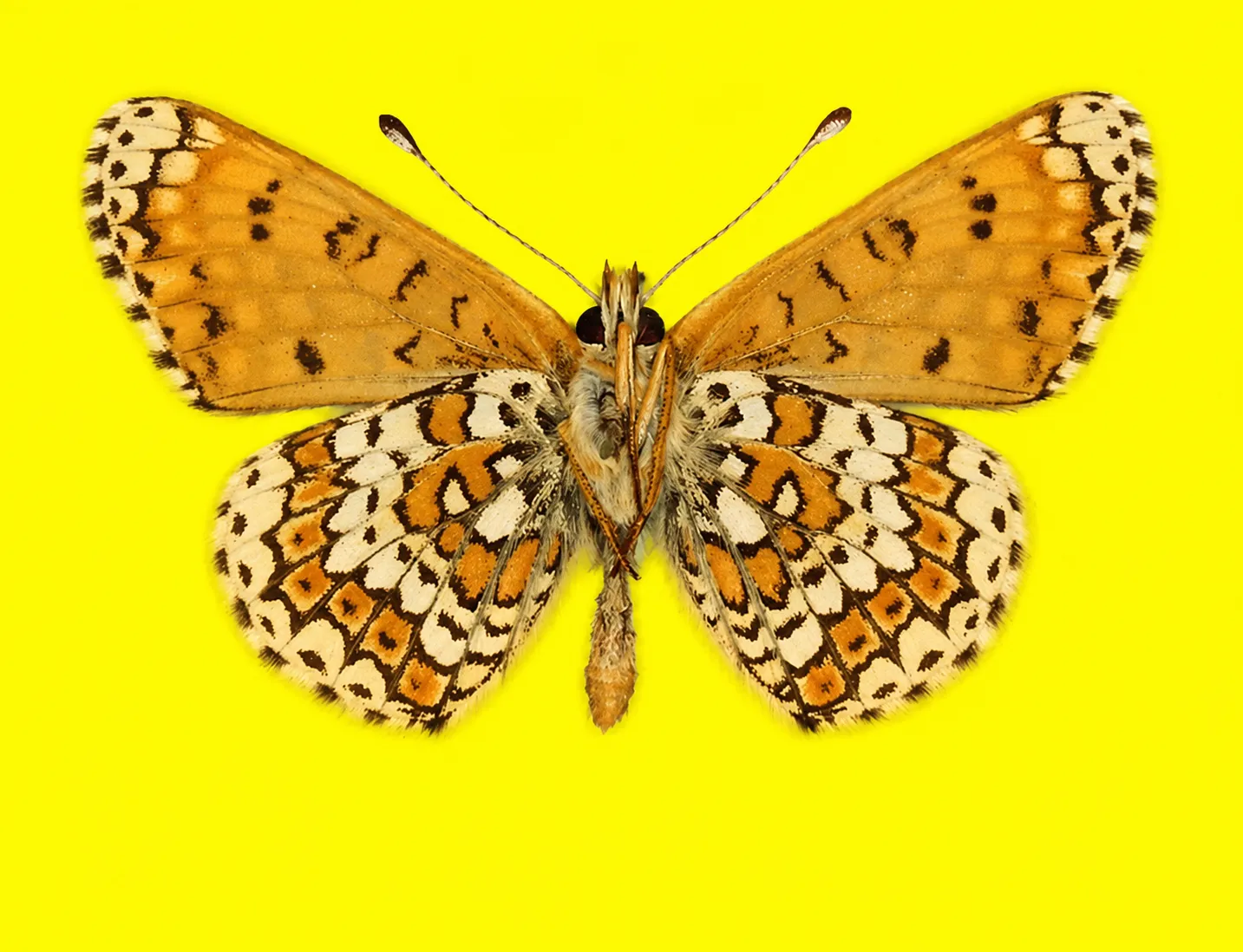
Only one native British butterfly is named after a British naturalist. It is the Glanville fritillary, Melitaea cinxia, and the woman it commemorates was posthumously declared insane on the grounds that she collected butterflies.
Eleanor
She was born Eleanor Goodricke in 1654. Her first marriage left her a wealthy widow; her second, in 1685, was to Richard Glanville, who was interested in the money. He became violent, took one of their sons away from her, and worked steadily on turning her children against her. She separated from him in the late 1690s and went back to something she had cared about as a girl.
What followed was about a decade of serious work. She collected across her Somerset estate, in the Lincolnshire marshes and along the coast, and used Bristol – ten miles away and full of ships – to get hold of specimens from the colonies. She reared butterflies from the larva, which almost nobody was doing properly, and produced some of the earliest careful descriptions of the process in English.
She corresponded with James Petiver, the London apothecary and collector, and sent him first-known specimens that went into his catalogue of British insects. She could not join the Royal Society, or attend a meeting of it, because she was a woman. She went to London in 1703 with her collection and the naturalists who saw it were, by their own accounts, put to shame by it.
Three of her insects are still in the Sloane collection at the Natural History Museum.
The will
Glanville died in 1709. Knowing what her husband was capable of, she had put her property in trust and left her children only small legacies, with the bulk going elsewhere.
Her eldest son, Forest Ashfield, contested it. The case for setting the will aside was that his mother had been out of her mind, and the evidence offered for this was, substantially, the butterflies.
Moses Harris put the argument on record in The Aurelian in 1766, more than fifty years later. Relations disappointed by the will attempted to overturn it by acts of lunacy, he wrote, on the suggestion that none but those deprived of their senses would go in pursuit of butterflies.
Witnesses described her behaviour in the field. Beating hedges with a sheet spread beneath them to catch what fell out is a standard collecting technique, and to somebody who does not know that, it is a woman thrashing a bush. There is also a claim, repeated by Michael Salmon in The Aurelian Legacy, that she had come to believe her children had been turned into fairies – which, if it was said in court at all, was said by people with a direct financial interest in her being mad.
Two endings
Here is where the story gets interesting, because it has two documented conclusions and they disagree.
Harris’s version is the happy one. A Mr Ray went down to Exeter, satisfied the judge and jury as to the lady’s laudable inquiry into the works of Creation, and the will was established.
That account has been repeated for two and a half centuries. It has a problem. The Mr Ray is generally taken to be John Ray, the greatest English naturalist of the age and the obvious person to summon. John Ray died in January 1705. Eleanor Glanville died in 1709.
The modern accounts, working from the records rather than from Harris, say the will was overturned in 1712, that Forest took the estate, and that he sold the land off.
I would not want to be dogmatic about which is right. But it is worth noticing what has happened here. The story that survived and got repeated is the one where the naturalists win, told by a naturalist, in a book for naturalists, half a century after the fact, with a witness in it who was already dead.
Why it stuck
The case became a standing joke and then a grievance within English entomology. W. S. Coleman was still bringing it up in 1862, complaining that the science was held in such low repute – mainly, he thought, because its objects were small – that a woman’s will could be attacked on no other evidence than her fondness for collecting insects.
That is the useful part. The trial is not really about one family’s money. It is a snapshot of the moment before natural history became respectable, when the difference between a collector and a lunatic was not yet settled and could be argued in front of a jury.
Within a century the same activity would be the most conventional hobby an English gentleman could have. Within two, it would be the basis of a science that reorganised our understanding of life. Glanville was doing it about forty years too early, as a woman, with a hostile husband and four disinherited children.
The butterfly is now one of the rarest in Britain, hanging on chiefly on the Isle of Wight, where the fritillary depends on cliffs slumping often enough to keep the sward short. It needs the ground to keep falling apart in order to survive, which is not a bad emblem, though I will leave it there.
We have no portrait of her. What we have is three pinned insects in a drawer in South Kensington, a species name, and a court record in which collecting butterflies is entered as a symptom.
Sources
- Moses Harris, The Aurelian (1766)
- Michael Salmon, The Aurelian Legacy
- Wikipedia and the Linda Hall Library on Eleanor Glanville
- the Eleanor Glanville Institute, University of Lincoln
- W. S. Coleman, British Butterflies (1862)
- Natural History Museum Sloane collection records