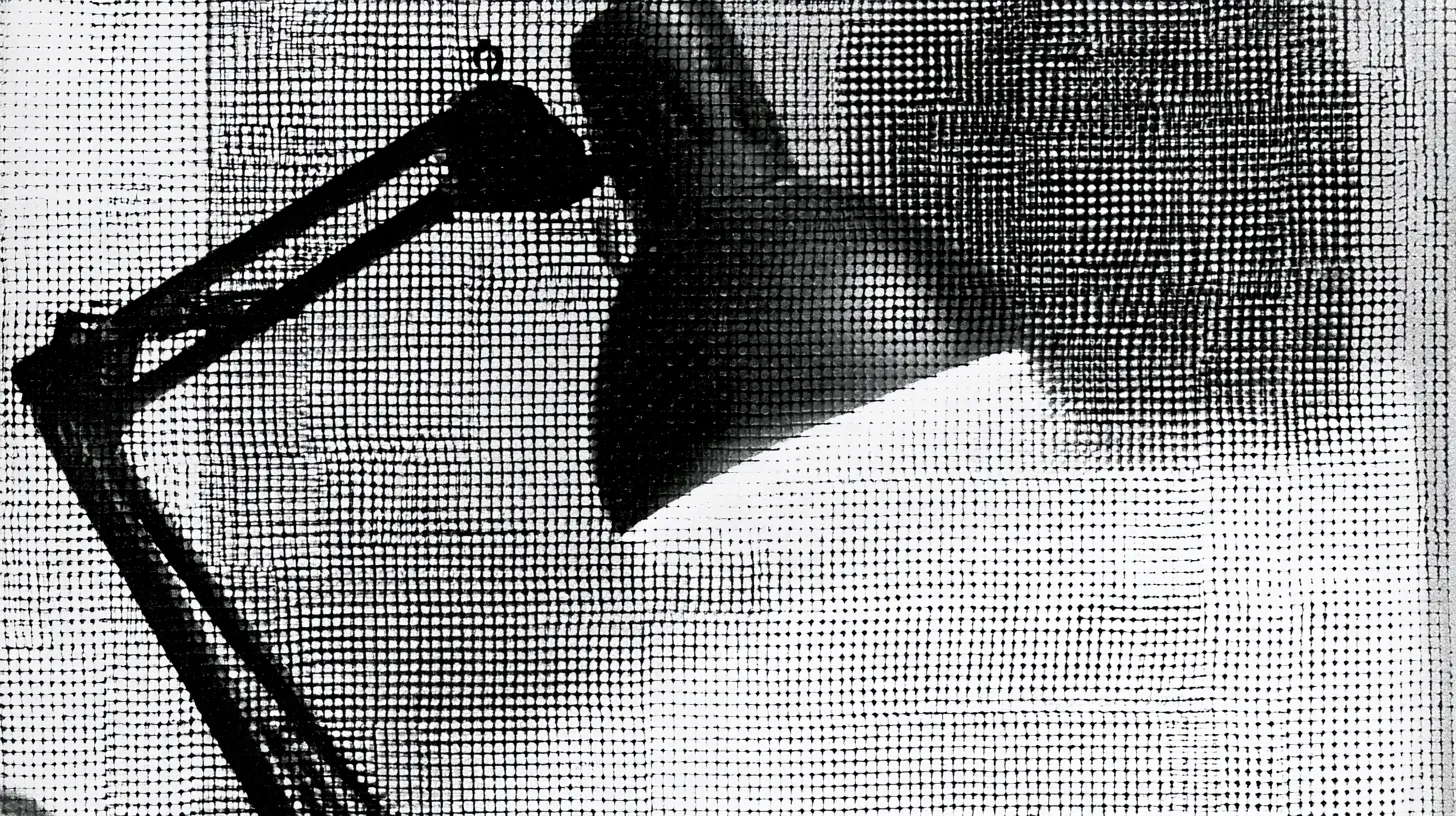
Under Glass · Jan 2026
A Lamp That Stays Put
A car suspension engineer solved a problem nobody framed right
The problem with an adjustable lamp is not adjustment. It is staying put.
Any hinge will let an arm move. The difficulty is that as soon as the arm is anywhere other than vertical, gravity is pulling on it, and the amount of pull changes continuously as the angle changes. Tighten the joints enough to hold it and you need two hands and some force to move it. Loosen them enough to move it easily and it sags.
Every adjustable lamp before 1932 was a compromise between those two failures, and most of them were bad ones.
Carwardine
George Carwardine was an automotive engineer in Bath who specialised in vehicle suspension systems, which is to say he spent his working life on the problem of springs that resist a varying load.
In 1932, he patented a mechanism using springs in tension, arranged so that the counterbalancing force they exert changes as the geometry changes — matching, at every position, the changing pull of gravity on the arm.
The result is an arm that is effectively weightless throughout its range. You can move it with one finger. It stops where you stop it. There is no locking, no tightening, no adjustment of friction, because friction is not doing the work.
The account he gave was that he had been thinking about the constant tension of a human limb — an arm that can be held out at any angle without effort or fixing.
He did not patent a lamp. He patented an equipoising mechanism, and the lamp came afterwards, as the obvious thing to hang on the end of it.
Redditch
Making it required a great many precise springs, which was not something Carwardine was set up for, so he licensed it to Herbert Terry & Sons of Redditch, who were spring manufacturers.
The first production version used four springs. In 1935 came a three-spring model, the 1227, with the perforated shade and the stepped base, and that is the lamp everybody pictures.
It went everywhere — drawing offices, machine shops, dentists’ surgeries, laboratories, sewing rooms and kitchen tables — because it was the only light in the world that would put itself exactly where a working person needed it and then stay there while they used both hands.
A version went into RAF bombers for the navigator’s table, where an unsecured light in turbulence is a serious problem.
The lamp looks the way it does because springs need anchor points and levers need length and the whole assembly has to be light enough for the springs to balance. Nobody sat down to style it. Every visible feature is load-bearing.
Sources
- George Carwardine (1887–1947), a vehicle suspension engineer in Bath, patented a spring-balanced arm mechanism in 1932 intended for general use rather than specifically for lighting
- The mechanism uses springs in tension to counterbalance the weight of the arm at any position, so the arm can be moved with light finger pressure and stays where it is left
- Carwardine licensed manufacture to Herbert Terry & Sons of Redditch, a spring maker; the four-spring model 1208 was followed by the three-spring 1227 of 1935, which became the classic form
- Widely adopted in workshops, drawing offices, surgeries and homes; a version was used in RAF bomber navigation stations during the Second World War