Folk Ways · Aug 2025
Things You Can't Say at Sea
Occupational taboo, and why it clusters around dangerous trades
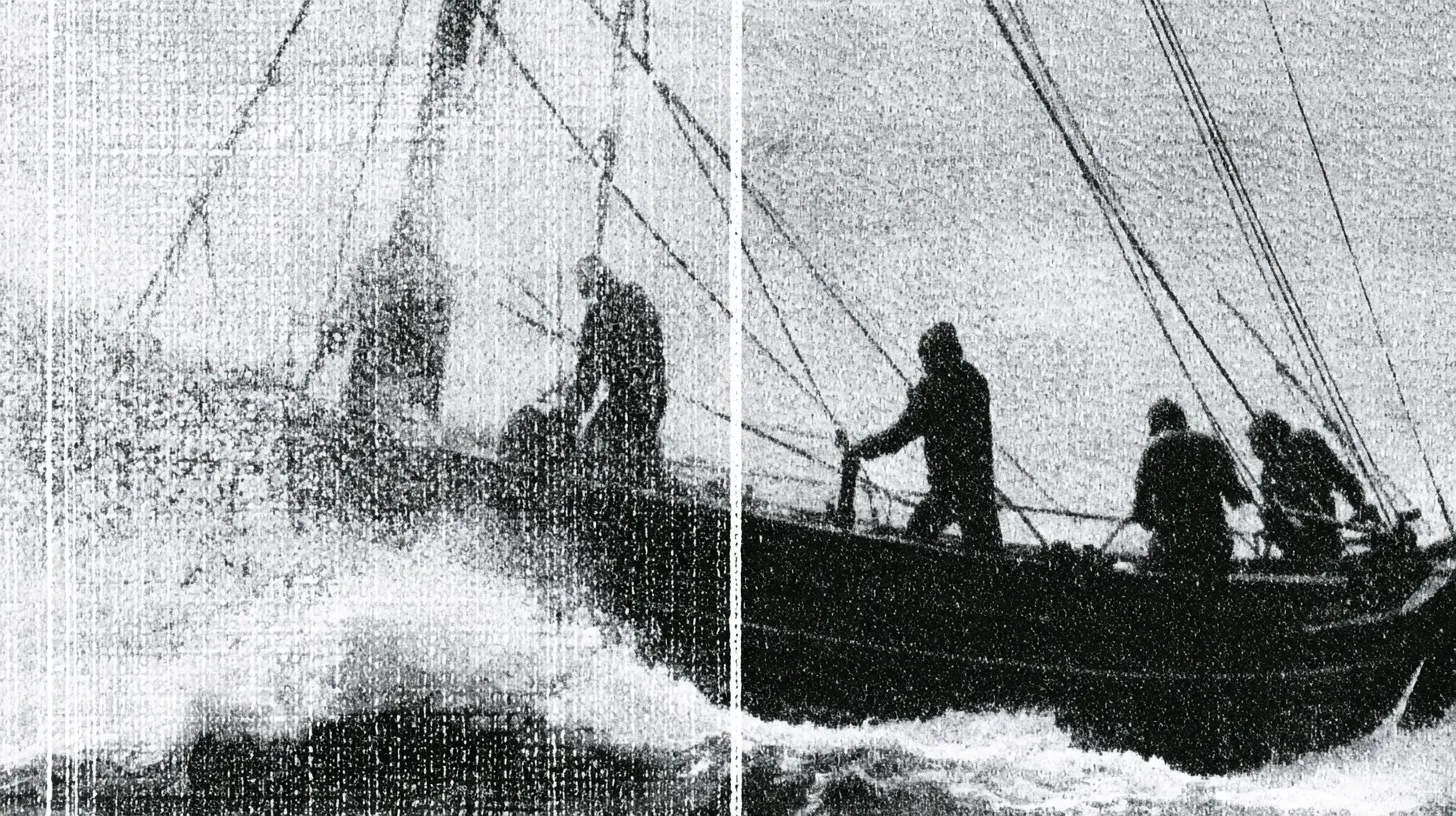
On many British fishing boats, within living memory and in some places still, there were words you did not say once you had left the house.
The lists differ by port, but certain items recur. Pig. Rabbit. Hare. Salmon. Church, and minister, and priest. Knife, in some places.
If the word was needed, a substitute was used — the animal with the curly tail, the long-eared beast, the red fish — and everybody aboard knew what was meant.
Meeting the wrong thing on the way to the boat could turn a crew round: a rabbit crossing the road, a woman with red hair, a clergyman. Men who had walked to the harbour in the dark went home again.
Not just fishermen
This belongs alongside the other trades, because the pattern repeats.
Actors do not say Macbeth inside a theatre and use a circumlocution instead, and there is a prescribed remedy if somebody does. Miners had their own prohibitions, on whistling underground and on particular words at the coalface. Similar rules are recorded among sailors, steeplejacks and, in some accounts, aircrew.
Four different trades, no contact between them, the same structure: a small number of arbitrary words that must not be spoken in a specific place, with substitutions available and a remedy for breach.
What they have in common
The trades where you find this are the trades where skill runs out.
A fisherman in an open boat can be extremely good at his job — better than anyone else in the fleet — and still be drowned by weather he could not have predicted, in a sea he did not choose. Diligence improves the odds and does not settle them. The same is true of a coal seam, and of a live theatre where anything can go wrong in front of several hundred people.
That produces a specific psychological problem. Human beings are not able to hold, for a working lifetime, the position that their survival is substantially arbitrary. It is not sustainable and it is not compatible with getting into the boat.
A taboo solves it. If disaster follows from a nameable cause — somebody said the word, somebody met a minister on the pier — then disaster becomes something with rules, and rules can be followed. The rule is arbitrary, and everybody involved is at some level aware that it is arbitrary, and that does not matter in the slightest.
What is being managed is not the sea. It is the crew’s ability to go out on it repeatedly.
Why it is a group rule and not a private one
These are collective and enforced.
A private superstition would do the psychological work just as well. But the fishing taboos apply to everybody aboard, breaches are treated as serious, and an offender may be put ashore.
That points at the second function, which is social. A crew in a small boat in bad weather has to act as one thing, instantly, without discussion. Shared observance of an arbitrary rule is a very efficient way of establishing who is inside the group and whether they can be relied on to do what they are told.
An outsider who laughs at the word rule has told the skipper something useful before they have even left the harbour.
Where it stands
Modern boats have engines, radar, forecasts, satellite navigation and radio, and the risk has come down enormously — though fishing remains among the most dangerous occupations in Britain.
The taboos have thinned accordingly.
Sources
- Word taboos among British fishing communities are recorded from the east coast of Scotland and England, from Cornwall and from the Isle of Man; forbidden words vary by port but commonly include pig, rabbit, hare, salmon, church, minister and knife
- Substitutions were used in place of the forbidden word — the animal with the curly tail, and similar circumlocutions — and encountering certain people or animals on the way to the boat could cause a crew to turn back
- Comparable taboos are recorded in theatre (the avoidance of naming Macbeth within a theatre) and in mining and other high-risk trades
- Folklorists have generally interpreted such taboos as functional within uncontrollable risk rather than as survivals of specific ancient belief
- The practice was recorded in the twentieth century as still live in working fleets, and elements persist