Folk Ways · Dec 2025
Nobody Mentioned Him
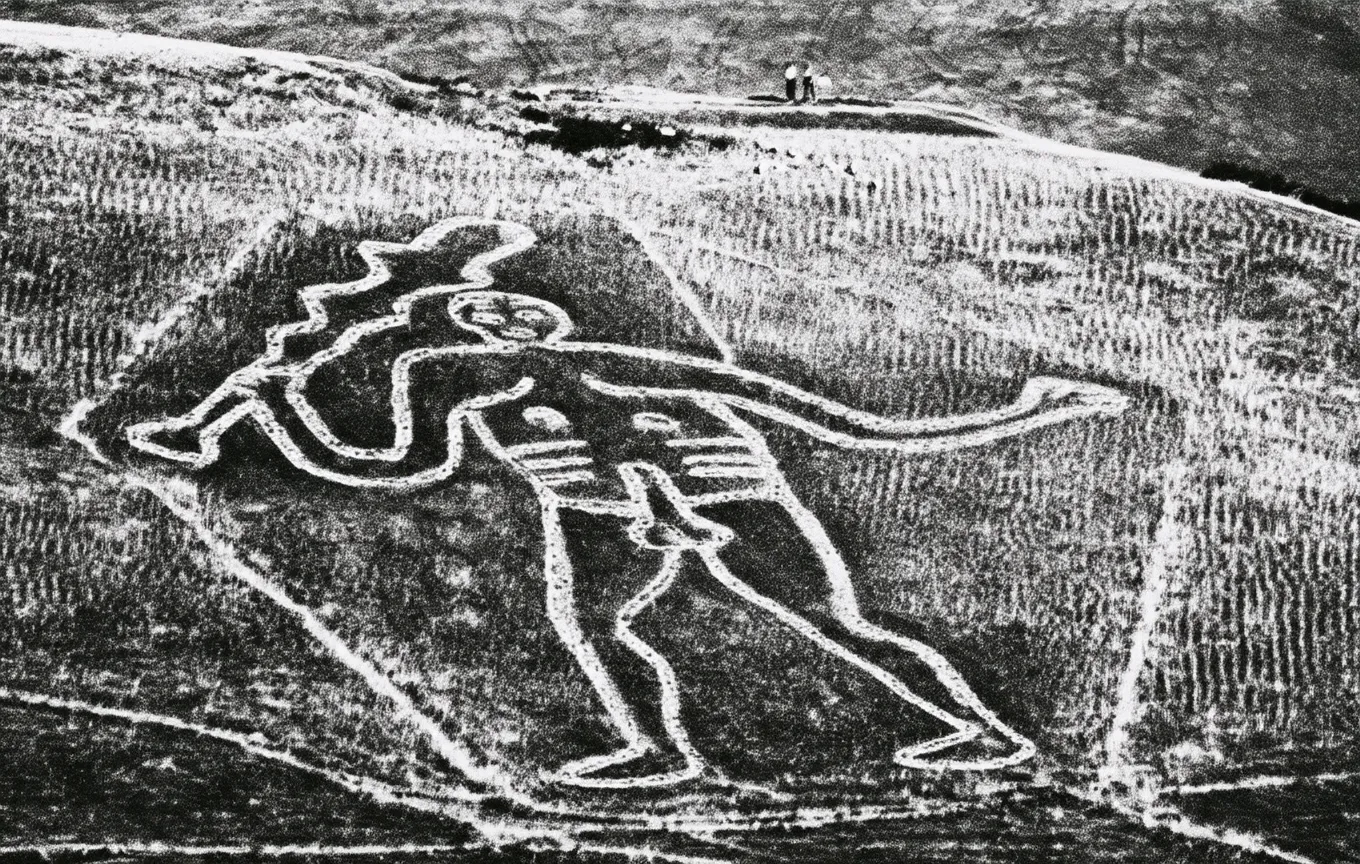
The Cerne Abbas Giant was dated in 2021 — it made things worse
In 2021, the National Trust dated the Cerne Abbas Giant, and the newspapers reported that a long-running mystery had been settled.
It had not been settled; it had been made considerably stranger.
The method
Phillip Toms at the University of Gloucestershire used optically stimulated luminescence, which establishes when a grain of sand was last exposed to daylight. Samples came from the giant’s elbows and feet.
What they found first was that the archaeology was much deeper than expected — about a metre of accumulated chalk, built up by centuries of people re-cutting and re-chalking the figure.
Material from the deepest layer returned a date range of AD 700 to 1100.
What that rules out
Three of the four standing theories, immediately.
He is not prehistoric. He is not an Iron Age fertility god, which was the romantic favourite.
He is not Roman, which had been the scholarly favourite — the club and the pose look very like Hercules, and there was a Hercules cult in late Roman Britain.
And he is not a seventeenth-century political cartoon. That theory held that he was a mockery of Oliver Cromwell, whose enemies called him England’s Hercules, cut by a local landowner as an enormous insult. It fitted the documentary evidence beautifully, and the dating kills it.
Why the answer is a problem
Because the period the science points to is the least plausible period there is.
The early medieval centuries have no recorded tradition of cutting hill figures in England. The practice appears before, in the Uffington White Horse, and it appears again in the Georgian period with the Wiltshire horses, and in between there is essentially nothing.
And there is no obvious place, in Anglo-Saxon Christian England, for a colossal naked man with an erection and a Herculean club. The number of knots on the club is specifically that of a classical Hercules, which points to a classical source that has no business being there in 900.
Then there is the snail evidence, which does not agree. Mike Allen’s analysis of molluscs in the earliest layer found two species that are medieval introductions to Britain and were not in the soil before the figure — pointing to a date later than the OSL result. Something in one dataset or the other is off.
And there is the silence. John Norden surveyed the area in 1617 and did not mention a two-hundred-foot naked giant on the hillside above the village.
The first documentary reference to him at all is a churchwardens’ payment for his repair, in 1694.
Where that leaves it
Martin Papworth, who led the work, has a suggestion worth taking seriously. Cerne Abbey was founded nearby in 987, and there is a tradition that it was established to convert local people who worshipped an Anglo-Saxon god called Heil or Helith. The giant may be that god — cut in the late Saxon period, disapproved of, allowed to grass over for centuries, and re-cut when somebody in the seventeenth century found the outline in the turf and decided to bring him back.
That would explain the deep layers, the early date, the documentary silence, and the sudden appearance in the record in the 1690s.
It is a hypothesis and it is not proven and the National Trust say so.
Which is the honest state of English hill figures generally. They are the most conspicuous prehistoric-looking objects in the landscape and almost none of them can be dated, because the only way to keep a chalk figure visible is to scour it, and scouring destroys the evidence of the last scouring.
The Trust sends volunteers up with chalk every decade or so, and the layer gets deeper.
Sources
- National Trust, 'History of the Cerne Giant' — OSL analysis by Professor Phillip Toms, University of Gloucestershire; samples from the elbows and feet; deepest layer at 1m gave AD 700–1100; Martin Papworth, NT senior archaeologist for Wessex
- The Art Newspaper and Current Archaeology, May 2021 — the result rules out prehistoric, Roman and seventeenth-century origins; funded by the National Trust, University of Gloucestershire, Allen Environmental Archaeology and the Pratt Bequest
- Mike Allen's mollusc evidence: Cernuella virgata and Candidula gigaxii in the earliest layer are medieval introductions, suggesting a later date than the OSL
- Wild Hunt, May 2021 — the full OSL spread runs 700–1300; no recorded tradition of hill-figure cutting in that period; the club's knots are specifically those of a classical Hercules
- The figure is absent from John Norden's 1617 survey; first documentary mention is a churchwardens' payment of 1694. The Trendle above him is an Iron Age earthwork. 55m tall; given to the National Trust by the Pitt-Rivers family in 1920